

Adler Planetarium: Stargazing in Chicago and the Future of Space Exploration
When most people think of Chicago, they picture deep-dish pizza, towering skyscrapers, or perhaps the bustling energy of the Magnificent Mile. But nestled on the shores of Lake Michigan lies one of the city’s most captivating treasures – the Adler Planetarium. This iconic institution has been inspiring wonder about the cosmos for nearly a century, making it America’s first planetarium and a beacon for space enthusiasts from around the globe.
Whether you’re a lifelong astronomy buff or someone who simply enjoys gazing up at the night sky, the Adler Planetarium offers an extraordinary journey through space and time. From its cutting-edge exhibits to its world-class stargazing opportunities, this Chicago landmark continues to push the boundaries of how we explore and understand our universe.
A Historic Gateway to the Stars
The Adler Planetarium opened its doors in 1930, thanks to the vision and generosity of businessman Max Adler. His dream was to create a place where the public could explore the wonders of astronomy in an immersive, educational environment. Nearly a century later, that vision has evolved into something far beyond what Adler could have imagined.
Located on Chicago’s Museum Campus, the planetarium sits like a celestial observatory overlooking Lake Michigan. Its distinctive Art Deco architecture makes it instantly recognizable, while its strategic location away from the city’s brightest lights provides surprisingly good conditions for urban stargazing. The building itself has become as much a part of Chicago’s identity as any other landmark, appearing in countless photographs with the city skyline as a backdrop.
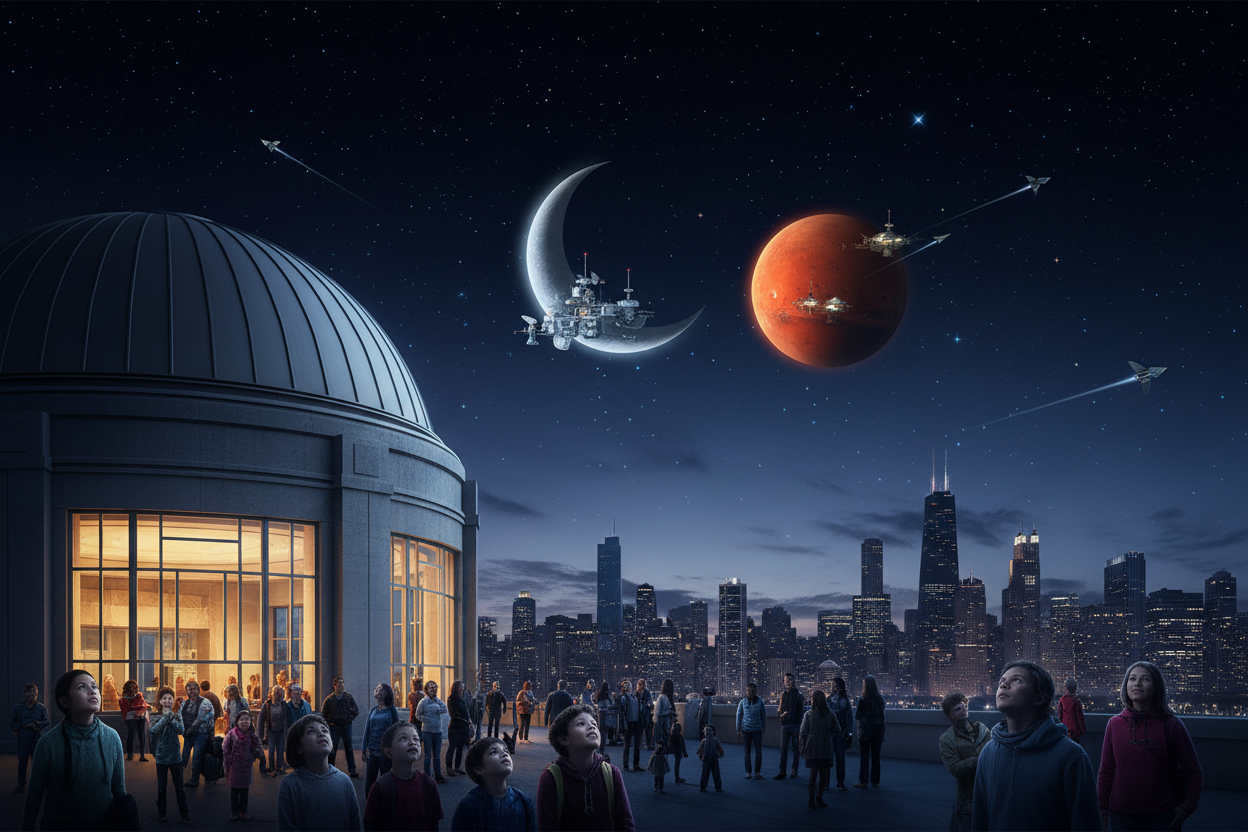
What truly sets the Adler apart is its commitment to making astronomy accessible to everyone. From the moment you step inside, you’re transported into a world where complex scientific concepts become tangible and exciting. The planetarium has weathered decades of technological advancement, consistently updating its offerings to reflect our ever-expanding understanding of the cosmos.
Cutting-Edge Exhibits That Bring Space to Life
The Adler Planetarium houses some of the most sophisticated astronomical exhibits in the world. The centerpiece is undoubtedly the Grainger Sky Theater, featuring a state-of-the-art digital projection system that creates breathtakingly realistic journeys through space. Unlike traditional planetariums that simply project star patterns onto a dome, this system can transport visitors to distant galaxies, inside nebulae, or even to the surface of Mars.
The Mission Moon exhibit deserves special mention for its historical significance and interactive elements. Here, visitors can explore humanity’s greatest space adventure through authentic artifacts, including pieces of lunar rock and spacecraft components. The exhibit doesn’t just tell the story of the Apollo missions; it helps visitors understand the incredible engineering challenges that had to be overcome to put humans on the moon.
For those fascinated by our solar system, the Planet Explorers exhibit offers hands-on experiences that make planetary science come alive. Visitors can experience what it might feel like to walk on different planets, understanding how gravity, atmosphere, and surface conditions vary throughout our cosmic neighborhood. These interactive elements make complex scientific concepts accessible to visitors of all ages.
Stargazing Opportunities in the Heart of Chicago
One might assume that stargazing in a major metropolitan area like Chicago would be nearly impossible due to light pollution. While it’s true that the city’s bright lights wash out many celestial objects, the Adler Planetarium has found creative ways to offer meaningful stargazing experiences right in the urban core.
The planetarium regularly hosts “Far Horizons” telescope viewing sessions on its outdoor terraces. These events take advantage of the facility’s lakefront location and use high-quality telescopes to reveal celestial objects that remain visible even under Chicago’s illuminated skies. During these sessions, visitors might observe the moon’s craters in stunning detail, spot the rings of Saturn, or catch glimpses of bright deep-sky objects.
What makes these stargazing sessions particularly special is the expert guidance provided by the planetarium’s astronomers and volunteers. They don’t just point telescopes at interesting objects; they tell the stories behind what you’re seeing. Learning about the mythology surrounding constellations, the physics behind stellar evolution, or the latest discoveries about exoplanets adds layers of meaning to the visual experience.
The planetarium also organizes special viewing events for significant astronomical phenomena. Whether it’s a lunar eclipse, a meteor shower, or a rare planetary alignment, these gatherings create a sense of community among Chicago’s astronomy enthusiasts. There’s something magical about sharing these cosmic moments with fellow stargazers while the city lights twinkle in the background.
Educational Programs That Inspire Future Explorers
Education has always been at the heart of the Adler Planetarium’s mission, and their programs reflect a deep understanding of how to inspire curiosity about space and science. The planetarium offers everything from preschool programs that introduce young children to basic concepts about day and night, to advanced workshops for high school students interested in pursuing careers in astronomy or aerospace engineering.
The “Space Visualization Laboratory” represents one of the most innovative educational approaches in the field. This facility uses the same software that professional astronomers and space agencies use to visualize complex data sets. Students can manipulate real astronomical data, creating their own journeys through the universe while learning about scientific methodology and data analysis.
Perhaps most importantly, these educational programs emphasize that space exploration isn’t just about looking backward at what we’ve accomplished, but forward to what’s possible. Students learn about current missions to Mars, plans for returning to the Moon, and the search for life beyond Earth. This forward-looking perspective helps young people see themselves as potential contributors to humanity’s next chapter in space.
The Future of Space Exploration
The Adler Planetarium doesn’t just celebrate past achievements in space exploration; it actively engages with the future of human space endeavors. The facility regularly updates its exhibits and programs to reflect current missions and emerging technologies that will shape our cosmic future.
Current exhibits explore the Artemis program’s plans to return humans to the Moon, this time with the goal of establishing a sustainable lunar presence. Visitors can learn about the technological challenges of living and working on the Moon, from developing reliable life support systems to utilizing lunar resources for fuel and construction materials.
The planetarium also addresses one of the most exciting frontiers in modern astronomy: the search for exoplanets and potentially habitable worlds. Through interactive displays and immersive presentations, visitors explore how astronomers detect planets orbiting distant stars and what conditions might be necessary for life to exist elsewhere in the universe.
Private space exploration receives significant attention as well. The rise of companies like SpaceX, Blue Origin, and Virgin Galactic has fundamentally changed the landscape of space exploration, making it more accessible and commercially viable than ever before. The Adler helps visitors understand how these developments might affect everything from satellite communications to space tourism.
Technology and Innovation at the Adler
Staying at the forefront of space education requires constant technological innovation, and the Adler Planetarium has embraced this challenge with enthusiasm. The facility’s digital infrastructure rivals that of major research institutions, allowing for real-time connections with space missions and astronomical observatories around the world.
Virtual reality has become an increasingly important tool in the planetarium’s educational arsenal. VR experiences allow visitors to walk on the surface of Mars, float through the International Space Station, or even travel to the edge of a black hole. These immersive technologies create emotional connections to space exploration that traditional exhibits simply cannot match.
The planetarium’s commitment to technological advancement extends beyond visitor experiences. Their research partnerships with universities and space agencies contribute to actual scientific discovery. The facility serves as a testing ground for new ways to visualize and interpret astronomical data, with findings that benefit the broader scientific community.
Planning Your Visit to the Adler Planetarium
A visit to the Adler Planetarium requires some planning to make the most of your experience. The facility offers various ticket options, from general admission that includes access to all exhibits, to premium packages that include sky shows and special presentations.
Timing your visit can significantly impact your experience. Weekend visits tend to be busier, especially during school vacation periods, but they also offer more programming options. Weekday visits provide a more intimate experience with exhibits and often better opportunities for in-depth conversations with staff members.
For the best stargazing opportunities, check the planetarium’s calendar for telescope viewing events. These typically occur on clear evenings and are often timed to coincide with interesting astronomical events. Even if you can’t attend an organized viewing session, the planetarium’s location offers some of the best urban stargazing opportunities in Chicago.
Conclusion
The Adler Planetarium stands as more than just a museum or tourist attraction; it’s a bridge between humanity’s cosmic past and our interstellar future. In a world where space exploration is rapidly evolving from government programs to private enterprises, institutions like the Adler play a crucial role in keeping the public connected to these developments.
Whether you’re inspired by the historical achievements of the Apollo program, fascinated by current missions to Mars, or excited about the possibility of space tourism, the Adler Planetarium offers something to spark your imagination. Its combination of cutting-edge technology, expert education, and genuine passion for space exploration creates an experience that stays with visitors long after they leave.
As we stand on the brink of a new era in space exploration, with plans for lunar bases, Mars colonies, and interstellar probes, the Adler Planetarium continues to serve its original mission: inspiring wonder about the cosmos and our place within it. For anyone interested in stargazing in Chicago or understanding the future of space exploration, a visit to this remarkable institution isn’t just recommended – it’s essential.