
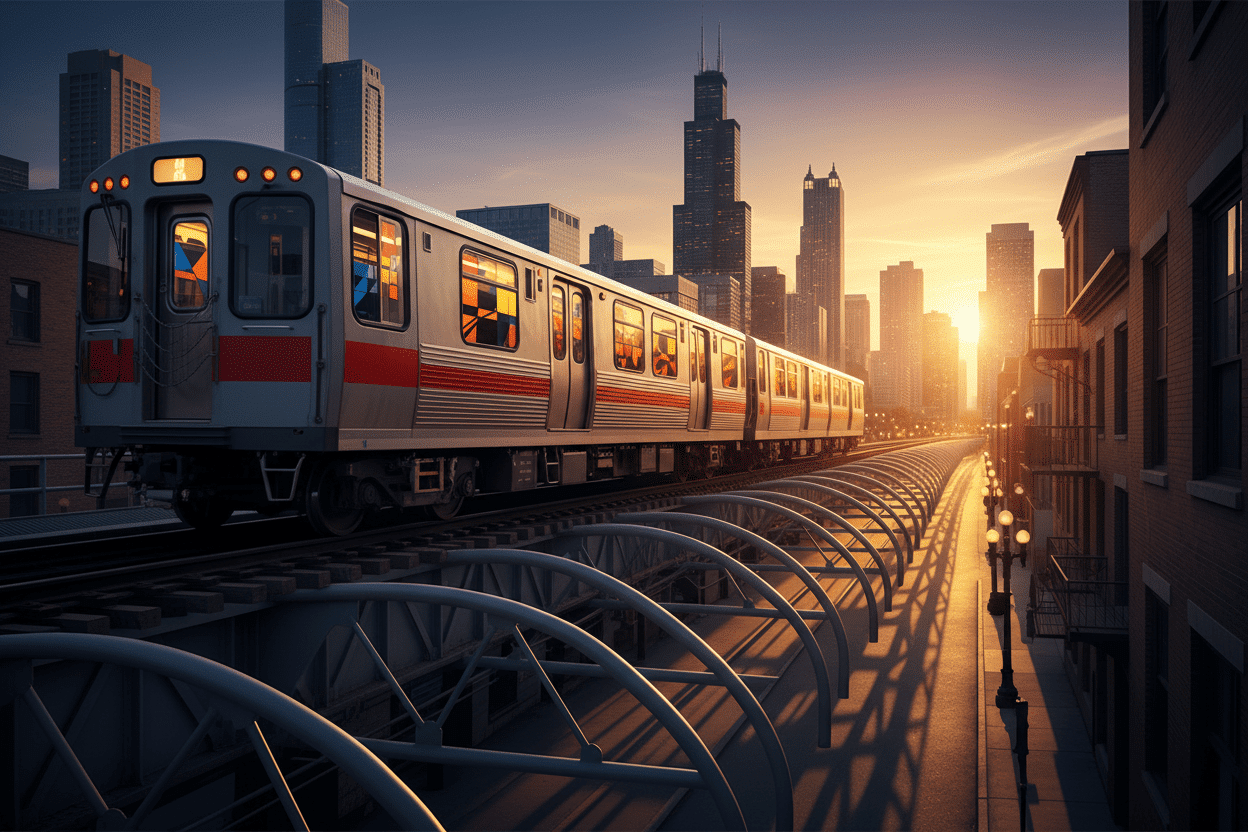
The Story of Chicago’s L Train: Public Transportation as Urban Art
When you think of Chicago, what comes to mind? Deep-dish pizza, towering skyscrapers, or perhaps the iconic elevated train system that snakes through the city like metallic veins? The Chicago L train isn’t just a mode of transportation—it’s a living, breathing piece of urban art that has shaped the city’s identity for over 130 years. From its humble beginnings as a solution to crowded streets to its current status as an architectural marvel, the L train tells the story of a city that dared to reach skyward.
Every day, hundreds of thousands of Chicagoans and visitors climb the worn steps to elevated platforms, waiting for the familiar rumble that announces an approaching train. But how many pause to appreciate the artistic legacy they’re experiencing? The Chicago Transit Authority’s elevated rail system represents one of the most successful marriages of function and form in urban planning history, proving that public transportation can be both practical and beautiful.
The Birth of an Icon: Chicago’s Elevated Railway Origins
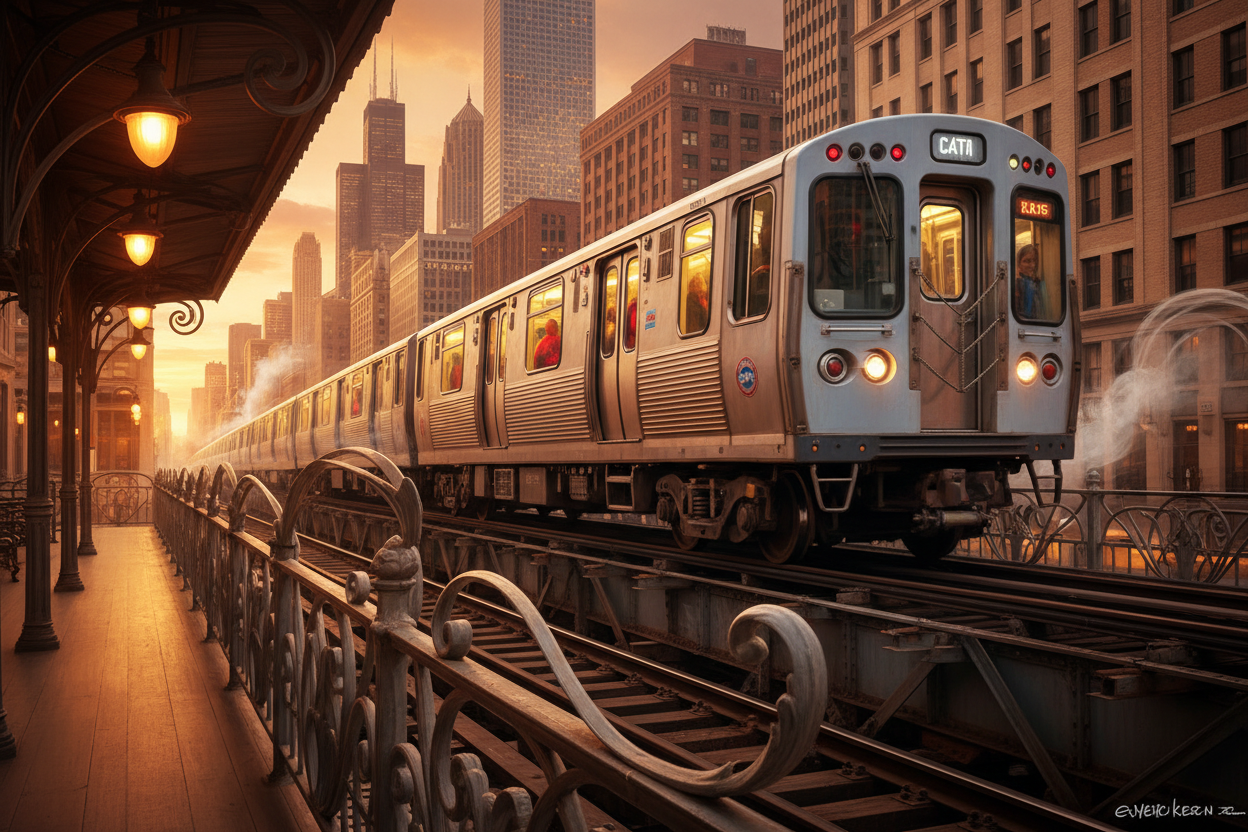
The story of Chicago’s L train begins in the 1890s, during a time when the city was bursting at the seams with growth. Street-level transportation had become a nightmare of congestion, with horse-drawn carriages, pedestrians, and early automobiles competing for space on increasingly crowded roads. City planners faced a dilemma: how do you move masses of people efficiently without adding to the chaos below?
The answer came from looking up. In 1892, the first section of Chicago’s elevated railway opened along what is now the Brown Line, running from downtown to the northwest side. This wasn’t just an engineering feat—it was an artistic statement. The decision to elevate the trains created an entirely new urban landscape, one that would inspire architects, photographers, and filmmakers for generations to come.
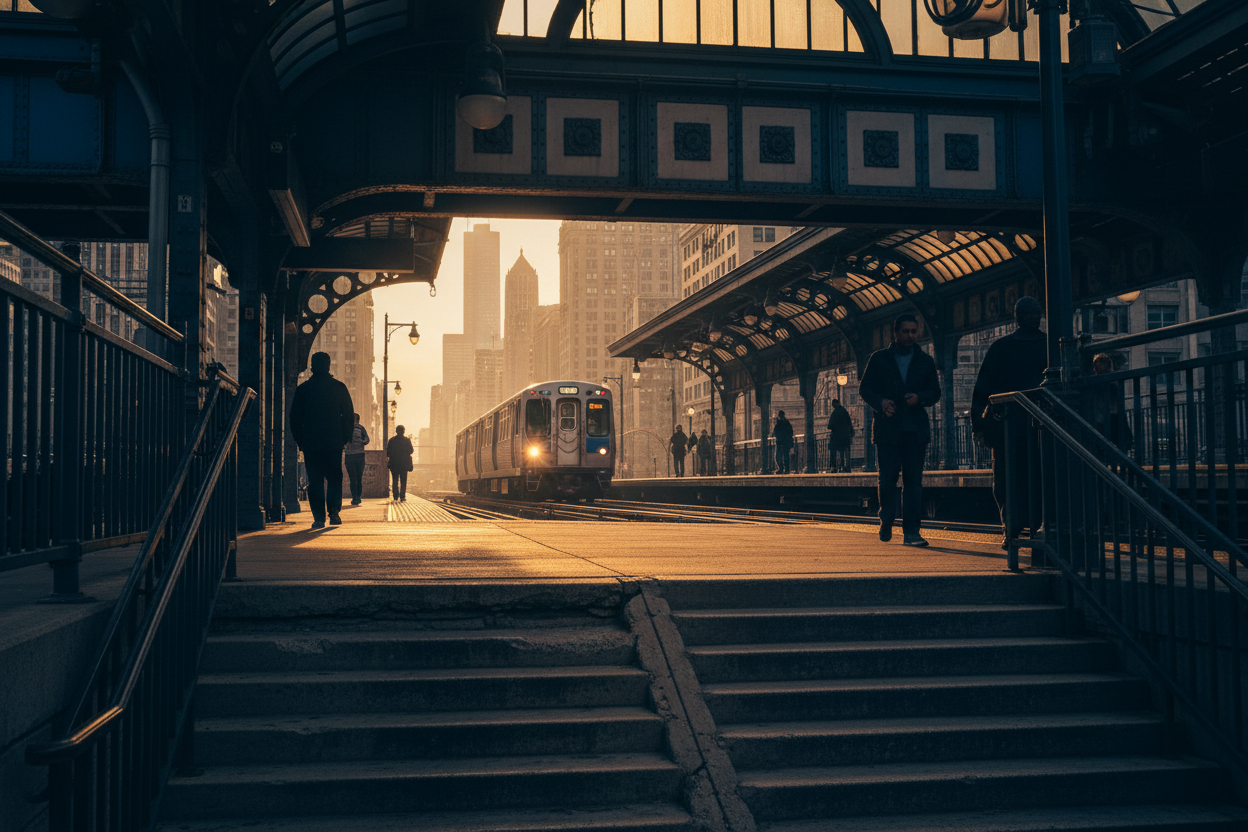
Unlike subway systems that hide underground, Chicago’s elevated approach put public transportation on display. The steel structures became part of the city’s skyline, creating dramatic shadows and geometric patterns that transformed ordinary streets into urban galleries. The L train didn’t just solve a transportation problem; it created a new aesthetic vocabulary for American cities.
Architectural Marvel: The Design Philosophy Behind the L
The Chicago L train system represents a masterclass in functional architecture. The original designers understood that they weren’t just building a railroad—they were creating a permanent fixture in the urban landscape that needed to complement, not compete with, the city’s architectural heritage.
The steel framework of the L tracks creates a distinctive visual rhythm throughout Chicago’s neighborhoods. These structures serve as urban sculptures, their repetitive arches and supports forming patterns that change with the viewer’s perspective. Walk beneath the tracks on Lake Street or Wabash Avenue, and you’ll experience a cathedral-like effect, with the elevated structure creating a canopy of shadows and light.
The stations themselves are works of art, each reflecting the character of its neighborhood while maintaining the system’s overall aesthetic coherence. From the historic charm of the Quincy station in the Loop to the modern glass and steel of newer stops, L train stations serve as community landmarks. They’re gathering places, architectural focal points, and gateways that define the identity of Chicago’s diverse neighborhoods.
The color-coding system of the L lines—Red, Blue, Brown, Green, Orange, Pink, Purple, and Yellow—adds another artistic dimension. These colors don’t just help passengers navigate; they create a visual language that maps the city’s geography in the collective imagination. When Chicagoans say they’re taking the “Red Line to the Sox game” or the “Blue Line to O’Hare,” they’re participating in a color-coded poetry of urban movement.
The L Train as Cultural Canvas
Beyond its architectural significance, the Chicago L train has become a canvas for cultural expression. The system has inspired countless artists, musicians, and writers who see in its daily rhythms the heartbeat of the city itself. The distinctive sound of trains crossing the steel tracks has become Chicago’s urban soundtrack, as recognizable as jazz in New Orleans or taxi horns in New York.
Street artists and muralists have embraced the L’s infrastructure as a backdrop for their work. The concrete supports and retaining walls along the tracks serve as galleries for community art projects, creating an ever-changing exhibition that passengers can enjoy from train windows. These collaborations between the transit authority and local artists demonstrate how public transportation can actively support cultural expression.
The L train has also played a starring role in Chicago’s representation in popular culture. From movies like “The Fugitive” to countless music videos and photographs, the elevated trains provide a instantly recognizable symbol of Chicago’s urban character. The dramatic angles and industrial beauty of the L system offer filmmakers and photographers a ready-made set that captures the city’s gritty elegance.
Riding the Rails: The Daily Art Experience
For the 750,000 daily riders of the Chicago L train, the artistic experience isn’t confined to museums or galleries—it’s part of their commute. The journey itself becomes a moving exhibition, with views that change seasonally and throughout the day. Summer mornings offer glimpses of rooftop gardens and architectural details invisible from street level, while winter evenings transform the city into a glittering light display visible through frost-covered windows.
The elevated perspective provides riders with a unique vantage point to appreciate Chicago’s architectural diversity. From the train, passengers can observe the city’s evolution in real-time, seeing how historic buildings interact with modern developments, how neighborhoods maintain their distinct characters, and how the urban landscape tells the story of Chicago’s growth.
Each line offers its own artistic journey. The Brown Line provides intimate views of Lincoln Park and Lakeview’s tree-lined streets, while the Green Line showcases the grandeur of the city’s South Side architecture. The Red Line cuts through the heart of downtown, offering passengers a front-row seat to the urban theater of Chicago’s business district.
Preservation and Evolution: Maintaining Urban Art
Maintaining a 130-year-old transportation system that doubles as public art presents unique challenges. The Chicago Transit Authority has embraced the responsibility of preserving the L train’s historic character while updating it for modern needs. Recent renovation projects have focused on maintaining the system’s architectural integrity while improving functionality and accessibility.
The restoration of historic stations like the Quincy stop demonstrates how preservation efforts can enhance both the artistic and practical value of public transportation. These projects don’t just maintain old structures; they celebrate the L train’s role as living urban art, ensuring that future generations can experience the same aesthetic pleasure that has defined Chicago transit for over a century.
New additions to the system continue this tradition of functional artistry. Modern stations incorporate contemporary design elements while respecting the visual language established by their predecessors. The result is a transportation network that feels both timeless and current, proving that public infrastructure can evolve without losing its artistic soul.
The Global Impact: Chicago’s L as Urban Planning Inspiration
Chicago’s elevated train system has influenced urban planning and public transportation design worldwide. Cities facing similar challenges of moving large populations efficiently while maintaining urban beauty have looked to Chicago’s model for inspiration. The L train proves that public transportation doesn’t have to be purely utilitarian—it can be a defining feature of a city’s aesthetic identity.
Urban planners and architects from around the world study Chicago’s L system to understand how transportation infrastructure can enhance rather than detract from urban environments. The system’s integration with the city’s architectural fabric offers lessons in how public works projects can contribute to a city’s cultural and artistic legacy.
The success of Chicago’s approach has encouraged other cities to view their transportation systems as opportunities for artistic expression and community building. From elevated parks built on abandoned rail lines to transit stations designed as community art centers, the influence of Chicago’s L train can be seen in urban planning projects across the globe.
Looking Forward: The Future of Artistic Transit
As Chicago continues to evolve, so does its beloved L train system. Future expansion plans and modernization efforts are being designed with the same attention to artistic integrity that has defined the system since its inception. New technologies and materials offer opportunities to enhance the L train’s role as urban art while improving its efficiency and accessibility.
The integration of digital art installations, improved lighting systems, and community-designed station elements promises to add new dimensions to the L train experience. These innovations build on the system’s artistic foundation while addressing the needs of contemporary urban life.
Climate change considerations and sustainability goals are also shaping the L train’s future, with green infrastructure and energy-efficient systems being integrated in ways that enhance rather than compromise the system’s aesthetic appeal. The challenge is maintaining the artistic character that makes the L train special while adapting to 21st-century environmental and social needs.
The Chicago L train stands as proof that public transportation can be more than just a way to get from point A to point B. It can be art, architecture, and cultural expression rolled into one essential urban experience. For over 130 years, the L has carried Chicagoans through their daily lives while simultaneously elevating their city’s aesthetic identity. As the system continues to evolve, it maintains its role as both practical infrastructure and living art, reminding us that the most beautiful cities are those where function and form dance together in perfect harmony. The next time you hear that familiar rumble approaching the platform, remember—you’re not just catching a train, you’re boarding a piece of Chicago’s artistic soul.