
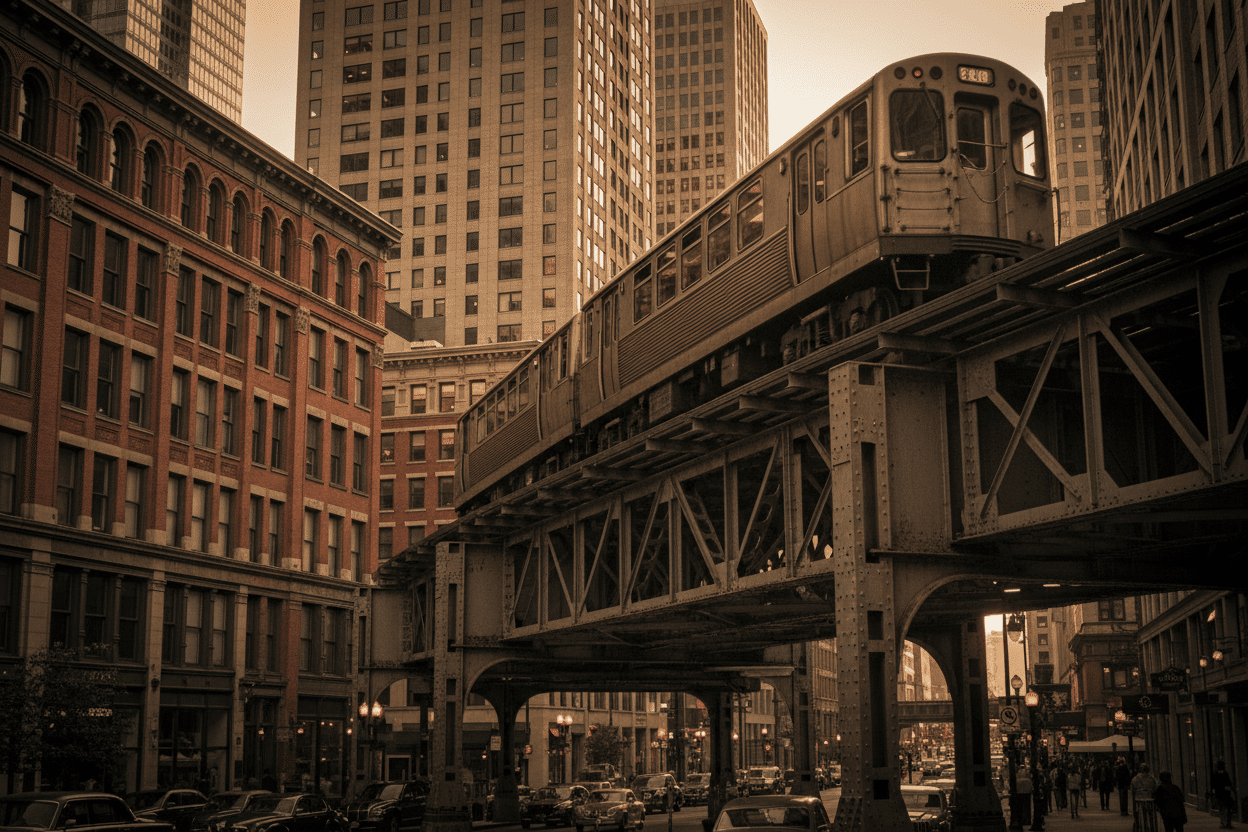
The History of Chicago’s Elevated Train: Engineering Marvel Above the Streets
When you walk through downtown Chicago today, it’s impossible to ignore the rumbling overhead as trains snake through the urban canyon on elevated tracks. The iconic “L” system isn’t just transportation—it’s a testament to human ingenuity and the bold vision of 19th-century engineers who dared to build above the bustling streets. This remarkable network of elevated railways transformed Chicago from a sprawling prairie town into a vertical metropolis, creating an engineering legacy that continues to inspire cities worldwide.
The Chicago elevated train system represents more than just steel and concrete; it embodies the spirit of innovation that has always defined the Windy City. From its humble beginnings as a solution to street-level congestion to its current status as one of America’s most extensive rapid transit networks, the L has witnessed Chicago’s evolution through fire, prosperity, and urban renewal.
The Birth of an Urban Transportation Revolution
Chicago’s elevated train story begins in the 1890s, during an era when the city was experiencing explosive growth following the Great Chicago Fire of 1871. The streets were clogged with horse-drawn carriages, pedestrians, and the early automobiles, creating a transportation nightmare that threatened to strangle the city’s economic progress.
The solution came from an unlikely source: Charles Tyson Yerkes, a Philadelphia financier with a controversial past but an undeniable vision for urban transportation. Yerkes recognized that the only way to move large numbers of people efficiently through Chicago was to go above the street-level chaos. His concept wasn’t entirely original—New York had experimented with elevated railways—but Chicago’s flat terrain and grid system made it an ideal testing ground for this revolutionary transportation method.
The first elevated line opened on June 6, 1892, running along a 3.6-mile route from Congress Street to 39th Street. This initial South Side Elevated Railroad proved that trains could successfully operate above city streets without disrupting ground-level traffic. The engineering challenges were immense, requiring innovative solutions for supporting massive steel structures while maintaining the flow of urban life below.
Engineering Challenges That Shaped Chicago’s Skyline
Building an elevated railway system in the 1890s required engineers to solve problems that had never been encountered before. The primary challenge was creating a structure strong enough to support heavy trains while minimizing the impact on street-level activities. Engineers developed an innovative system of steel columns and girders that could bear enormous loads while taking up minimal street space.
The foundation work proved particularly challenging in Chicago’s swampy soil conditions. Engineers had to drive steel piles deep into the ground to reach stable bedrock, sometimes going down 60 feet or more. Each support column required careful calculation to ensure it could handle not just the weight of the trains, but also the dynamic forces created by moving locomotives and the additional stress from Chicago’s notorious winds.
Weather presented another significant obstacle. Chicago’s extreme temperature variations—from sub-zero winters to sweltering summers—meant that the steel structure would expand and contract dramatically throughout the year. Engineers incorporated expansion joints and flexible connections that allowed the entire system to move safely with temperature changes, a innovation that became standard practice for elevated railways worldwide.
The curve engineering deserves special recognition. Creating smooth curves at elevated heights while maintaining passenger comfort and train safety required precise mathematical calculations and innovative track design. The famous Loop downtown, which gives Chicago’s business district its nickname, represents some of the most sophisticated railway engineering of its time.
The Great Chicago Fire’s Influence on Elevated Design
The devastating fire of 1871 profoundly influenced the design philosophy behind Chicago’s elevated system. City planners and engineers were determined to create infrastructure that could survive similar disasters. This led to the extensive use of steel and concrete rather than wood, making the elevated system one of the most fire-resistant transportation networks of its era.
The fire had also cleared large swaths of the city, providing engineers with relatively clean slates for planning elevated routes. This tragic event inadvertently created opportunities for more efficient track layouts and station placements that might have been impossible in a fully developed urban environment.
Lessons learned from the fire influenced safety protocols that became integral to the L system. Multiple escape routes, fire-resistant materials, and emergency procedures were built into the system from its earliest days, establishing safety standards that other cities would later adopt for their own rapid transit systems.
Expansion and the Formation of the Loop
The success of the initial South Side line sparked rapid expansion throughout the 1890s. The Lake Street Elevated Railroad opened in 1893, followed by the Metropolitan West Side Elevated Railroad in 1895, and the Northwestern Elevated Railroad in 1900. Each line brought unique engineering challenges and solutions that advanced the overall sophistication of the system.
The creation of the Union Loop in 1897 marked a pivotal moment in Chicago’s transportation history. This downtown circuit connected all the individual elevated lines, creating a unified system that could efficiently distribute passengers throughout the city center. The Loop’s construction required unprecedented coordination between multiple railway companies and city officials, establishing a model for public-private transportation partnerships.
Building the Loop presented extraordinary engineering challenges. The tight curves and dense urban environment required innovative track design and support structures. Engineers had to thread the elevated tracks between existing buildings while ensuring the structural integrity of both the railway and surrounding structures. The result was a transportation hub that could handle thousands of passengers per hour while occupying minimal ground-level space.
Technological Innovations That Defined the System
Chicago’s elevated system pioneered numerous technological innovations that became standard features of urban rapid transit worldwide. The third rail electrical system, implemented in the early 1900s, eliminated the need for overhead wires and provided more reliable power delivery than earlier steam-powered trains.
Signal technology developed for the L system established safety protocols that prevented collisions and managed traffic flow on complex multi-line networks. The automatic block signal system, which prevented trains from entering occupied track sections, became a model for railway safety systems globally.
Station design innovations addressed the unique challenges of elevated platforms. Engineers developed weather-resistant structures that protected passengers from Chicago’s harsh climate while providing efficient crowd flow and emergency evacuation capabilities. The distinctive station architecture, with its steel framework and glass windscreens, became an iconic element of Chicago’s urban landscape.
Car design evolved specifically for elevated operation. The need for lighter weight vehicles that could handle sharp curves and frequent stops led to innovations in materials and construction techniques. These design principles influenced rapid transit car development throughout North America and beyond.
Impact on Chicago’s Urban Development
The elevated train system fundamentally altered Chicago’s growth patterns and urban development. Neighborhoods that gained L access experienced rapid commercial and residential development, while areas without convenient elevated service often stagnated. This transportation-driven development pattern created the framework for modern Chicago’s neighborhood structure.
The L enabled the development of Chicago’s first true skyscrapers by providing efficient transportation to downtown employment centers. Workers could live in outlying neighborhoods and commute quickly to jobs in the Loop, supporting both residential development in former prairie areas and commercial concentration in the city center.
Property values along elevated lines increased dramatically, creating wealth for landowners while sometimes displacing lower-income residents. This pattern of transportation-driven gentrification became a model that urban planners would study and attempt to manage in future rapid transit developments.
The elevated system also influenced Chicago’s famous grid street pattern. The need to accommodate elevated support columns and maintain sight lines for train operations reinforced the city’s commitment to wide, straight streets laid out in regular patterns.
Challenges and Adaptations Through the Decades
The Chicago elevated system faced numerous challenges throughout its history, from economic downturns to changing transportation preferences. The Great Depression severely impacted ridership and maintenance funding, forcing system operators to find creative solutions for keeping trains running with limited resources.
The rise of automobile ownership in the mid-20th century posed an existential threat to elevated train ridership. Many cities abandoned their rail systems during this period, but Chicago’s L survived through strategic route adjustments, service improvements, and integration with bus networks.
Aging infrastructure became a major concern by the 1970s, with some sections of the elevated system approaching 80 years of continuous operation. Major rehabilitation projects required innovative engineering solutions to upgrade tracks, signals, and structures while maintaining service on one of America’s busiest transit networks.
Environmental concerns led to significant modifications in recent decades. Noise reduction efforts, energy efficiency improvements, and integration with sustainable transportation options have kept the century-old system relevant for modern environmental standards.
Modern Legacy and Continuing Innovation
Today’s Chicago L system carries over 750,000 passengers daily across eight color-coded lines spanning 224.1 miles of track. The engineering principles established in the 1890s continue to guide system operations and expansion, though modern technology has enhanced safety, efficiency, and passenger comfort.
Recent innovations include automated train control systems, real-time passenger information displays, and energy-efficient rail cars that build upon the engineering legacy of the original elevated system. The fundamental design concepts—elevated tracks, third rail power, and loop-based downtown distribution—remain essentially unchanged from the 19th-century vision.
The L continues to influence urban planning and transportation policy worldwide. Cities considering rapid transit development still study Chicago’s elevated system as a model for combining engineering efficiency with urban integration. The system’s ability to move large numbers of people while preserving street-level space remains relevant for modern urban challenges.
Chicago’s elevated train system stands as one of the great engineering achievements of the industrial age. From its origins as a solution to 19th-century street congestion to its current role as the backbone of metropolitan Chicago’s transportation network, the L represents the power of bold engineering vision combined with practical problem-solving. The steel and concrete structures that seemed so futuristic in the 1890s have become integral elements of Chicago’s identity, proving that truly innovative engineering creates legacies that endure far beyond their original purpose. As Chicago continues to evolve, its elevated trains remain a testament to the engineering pioneers who dared to build above the streets and forever changed the way cities think about urban transportation.