The Real Story Behind Chicago’s Green River: St. Patrick’s Day Tradition Explained
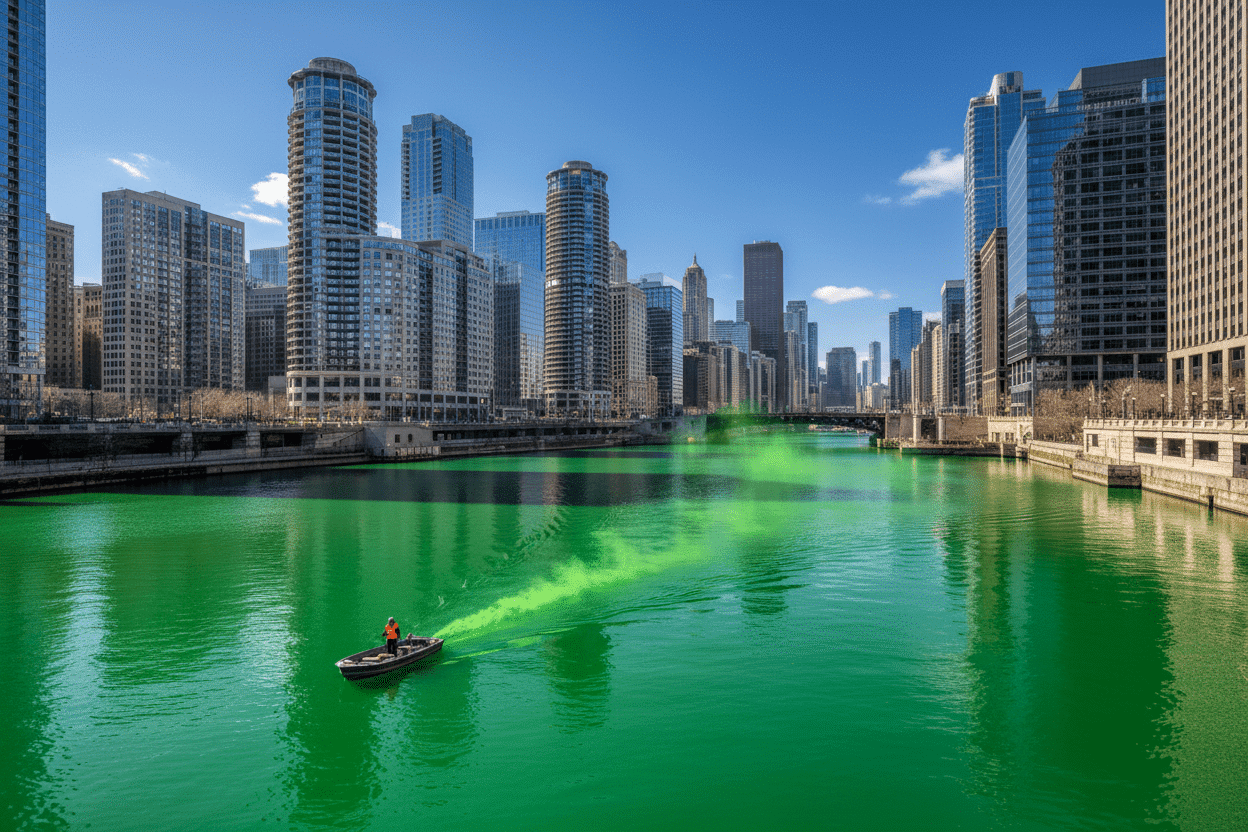
Every March, millions of people around the world witness one of the most spectacular St. Patrick’s Day traditions as Chicago’s river transforms into a brilliant emerald waterway. The Chicago River dyeing has become synonymous with St. Patrick’s Day celebrations, drawing tourists from across the globe and creating countless Instagram-worthy moments. But have you ever wondered how this incredible tradition began, or what actually makes the river turn that vibrant shade of green?
The story behind Chicago’s green river is far more fascinating than most people realize, involving plumbers, environmental concerns, and a tradition that’s evolved dramatically over the decades. This beloved Chicago tradition has deep roots in the city’s Irish heritage and represents one of the most unique ways any city celebrates St. Patrick’s Day worldwide.
The Origins of Chicago’s Green River Tradition
The Chicago River dyeing tradition didn’t start as a St. Patrick’s Day celebration at all. Back in 1962, the idea originated from a rather practical source: the Chicago Journeymen Plumbers Local Union 130. The union’s business manager, Stephen Bailey, was working with a special dye used to detect illegal sewage discharges into the river system.
The story goes that Bailey noticed his white overalls had been stained bright green by this tracer dye during a pollution detection job. As he walked through downtown Chicago, people kept commenting on the striking green color. This sparked an idea that would eventually become one of America’s most famous St. Patrick’s Day traditions.
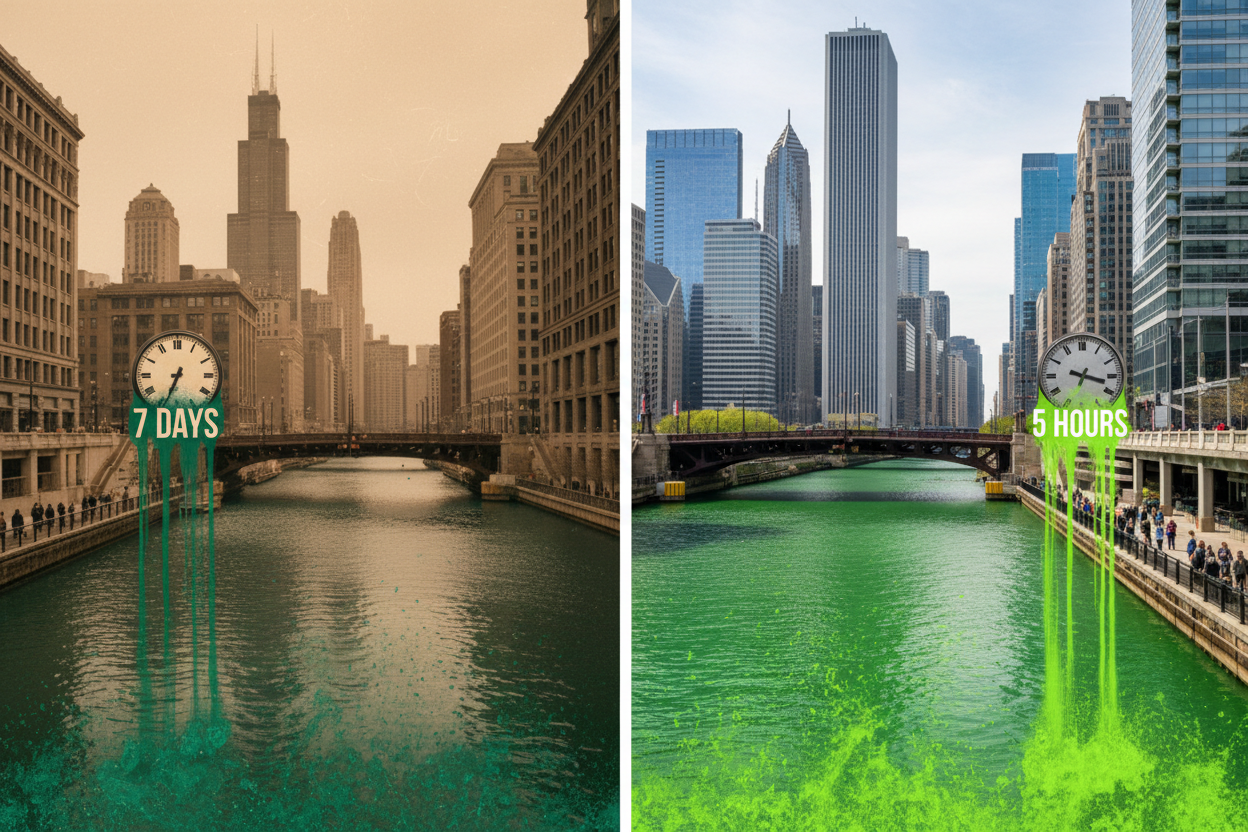
Bailey approached the city with a proposal to dye the entire Chicago River green for St. Patrick’s Day 1962. The idea was met with enthusiasm, and that first year, they used 100 pounds of dye to turn the river green for an entire week. The spectacle was so successful that it immediately became an annual tradition, though the process has been refined significantly over the years.
The Science Behind the Green: What Actually Colors the Water
Many people assume that the Chicago River is dyed with food coloring or some type of paint, but the reality is much more sophisticated. The original dye used was indeed the same fluorescein-based tracer dye that plumbers used for leak detection. However, environmental concerns led to changes in the formula over the years.
Today, the exact composition of the dye is kept secret by the Chicago Journeymen Plumbers Local Union 130, who still handle the dyeing process. What we do know is that the current formula is environmentally safe and vegetable-based. The dye is completely harmless to aquatic life and breaks down naturally without leaving any lasting environmental impact.
The process itself is quite remarkable. The dye starts as an orange powder that’s mixed with water before being released into the river. As it disperses through the water, a chemical reaction occurs that transforms the orange mixture into that brilliant green color that Chicago is famous for. The transformation happens almost instantly, creating a dramatic visual effect that never fails to amaze spectators.
The Dyeing Process: A Carefully Orchestrated Event
The actual dyeing of the Chicago River is a carefully planned operation that takes place on the Saturday before St. Patrick’s Day each year. The Chicago Journeymen Plumbers Local Union 130 has exclusive rights to perform this task, and they’ve turned it into a well-choreographed spectacle.
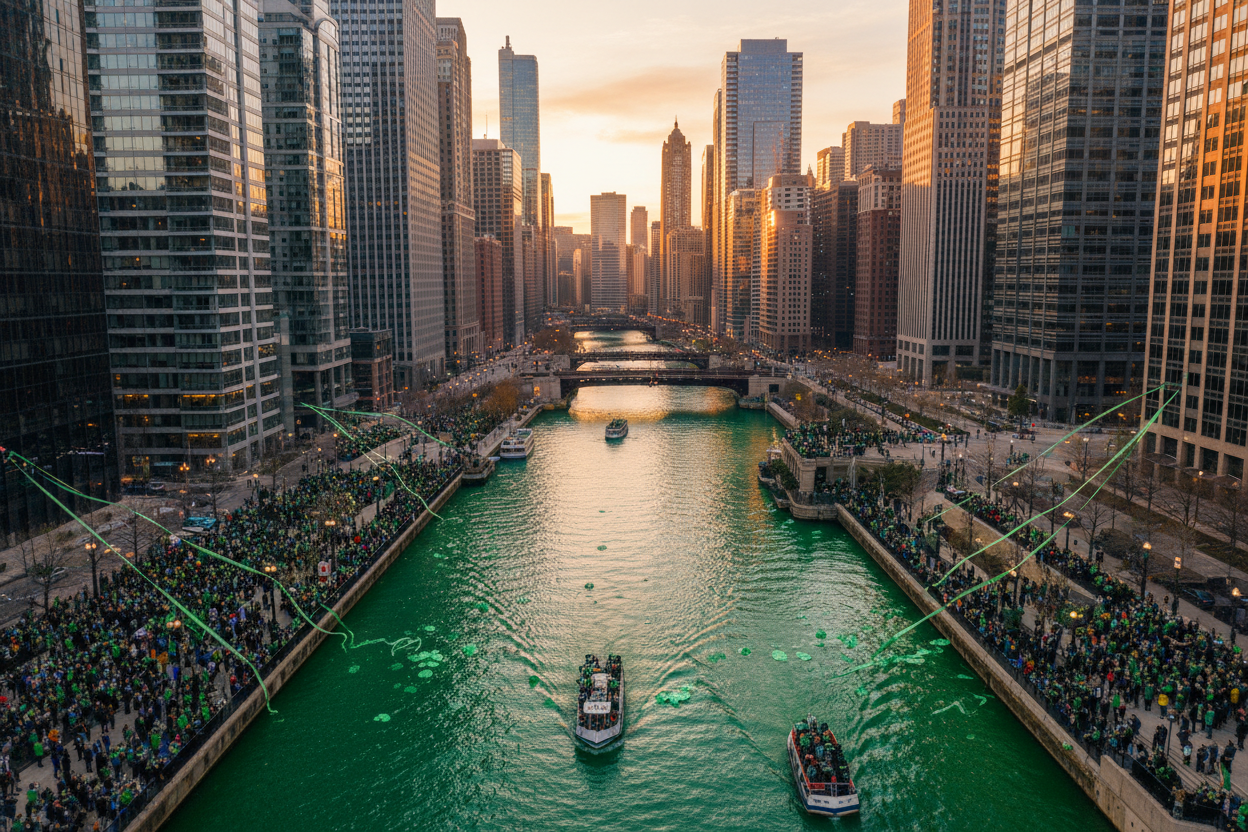
The process begins early in the morning, typically around 9:00 AM, when crowds start gathering along the riverbanks and bridges. Two boats are used in the operation: one to distribute the dye and another to help mix it through the water using the boat’s wake. The lead boat spreads the dye mixture in a specific pattern while the second boat follows behind, creating turbulence that helps distribute the color evenly throughout the water.
The entire dyeing process takes about 45 minutes to complete, but the visual transformation is immediate and dramatic. Spectators can watch as the river changes from its typical brownish-green color to a vibrant emerald that seems almost supernatural. The color typically lasts for about five hours, though weather conditions can affect how long the green remains visible.
Environmental Considerations and Modern Adaptations
As environmental awareness has grown over the decades, the Chicago River dyeing tradition has adapted to meet modern ecological standards. The original fluorescein dye, while generally safe, raised some environmental concerns among scientists and activists. In response, the plumbers union worked with environmental experts to develop a new formula that maintains the visual impact while ensuring complete safety for the river ecosystem.
The current dye formula is biodegradable and poses no threat to fish, birds, or other wildlife that depend on the Chicago River system. The amount of dye used has also been significantly reduced from the original 100 pounds to approximately 40 pounds today. This reduction doesn’t diminish the visual effect but demonstrates the organizers’ commitment to environmental responsibility.
Regular water quality testing is conducted before and after the dyeing to ensure that the river’s ecosystem remains unaffected. The Chicago Department of Environment has consistently found that the dyeing process has no measurable negative impact on water quality or aquatic life.
Cultural Impact and Tourism Boost
The Chicago River dyeing has become much more than a local tradition; it’s evolved into a major cultural event that significantly impacts the city’s tourism industry. Each year, hundreds of thousands of people flock to Chicago specifically to witness this unique spectacle, generating millions of dollars in tourism revenue for the city.
The event has been featured in countless movies, television shows, and documentaries, helping to establish Chicago’s reputation as a city that knows how to celebrate. Social media has amplified the tradition’s reach even further, with photos and videos of the green river going viral every March and inspiring people from around the world to add Chicago to their travel bucket lists.
Local businesses have embraced the tradition as well, with restaurants and bars offering special St. Patrick’s Day menus and green-themed promotions throughout the weekend. Hotels often book solid months in advance for the St. Patrick’s Day weekend, and many visitors plan their entire Chicago vacation around witnessing the river dyeing.
The Tradition’s Evolution Through the Decades
While the core concept of dyeing the Chicago River green has remained constant since 1962, many aspects of the tradition have evolved over the years. The most significant change has been the reduction in both the amount of dye used and the duration of the green color. In the early years, the river would stay green for up to a week, but today’s more concentrated formula keeps the color vibrant for about five hours.
The ceremony has also become more formalized and regulated over time. What started as a somewhat spontaneous event has evolved into a carefully planned spectacle with designated viewing areas, security measures, and media coverage. The Chicago Journeymen Plumbers Local Union 130 has maintained exclusive rights to perform the dyeing, ensuring consistency and safety in the process.
Weather has occasionally forced postponements or modifications to the tradition. In particularly harsh winters, ice on the river has delayed the dyeing, and strong winds have sometimes affected how evenly the dye disperses. However, these challenges have only added to the tradition’s mystique and the anticipation surrounding each year’s event.
Beyond Chicago: Inspiring Similar Traditions Worldwide
Chicago’s success with the green river has inspired numerous other cities to create their own St. Patrick’s Day water dyeing traditions. Cities like San Antonio, Texas, and Savannah, Georgia, have dyed their rivers green in honor of St. Patrick’s Day, though none have achieved quite the same level of fame or spectacle as Chicago’s version.
The tradition has also influenced other creative St. Patrick’s Day celebrations around the world. Some cities have experimented with dyeing fountains, waterfalls, and even snow green for the holiday. However, Chicago’s river dyeing remains the gold standard and the most recognized water-dyeing tradition associated with St. Patrick’s Day.
Planning Your Visit to See the Green River
If you’re planning to witness this incredible tradition firsthand, timing and location are crucial. The dyeing typically occurs on the Saturday before St. Patrick’s Day, starting around 9:00 AM. The best viewing spots are along the Chicago Riverwalk, particularly near the Michigan Avenue Bridge, Columbus Drive Bridge, and Lake Shore Drive Bridge.
Arriving early is essential, as prime viewing spots fill up quickly. Many spectators arrive as early as 7:00 AM to secure good positions along the riverbank. Dress warmly, as March weather in Chicago can be quite cold, and bring a camera to capture this once-a-year spectacle.
The tradition of dyeing the Chicago River green represents the perfect blend of Irish heritage, American innovation, and environmental consciousness. What started as a practical solution to a plumbing problem has evolved into one of the world’s most unique and beloved St. Patrick’s Day celebrations. Each year, as that brilliant green color spreads across the Chicago River, it serves as a reminder of how creativity, tradition, and community spirit can combine to create something truly magical that brings people together from around the world.