Grant Park’s Hidden History: Uncovering the Secrets of Chicago’s Front Yard
Every day, thousands of Chicagoans and tourists stroll through Grant Park without realizing they’re walking through one of America’s most historically rich urban spaces. Known affectionately as “Chicago’s Front Yard,” this 319-acre green oasis holds secrets that span centuries, from ancient Native American settlements to modern-day cultural landmarks. While most visitors know Grant Park for Millennium Park, the Art Institute, or summer festivals, the true stories buried beneath its manicured lawns and tree-lined paths reveal a fascinating tapestry of ambition, controversy, and transformation that mirrors Chicago’s own tumultuous history.
The Ancient Foundations: Before Chicago Was Chicago
Long before Daniel Burnham dreamed of a “City Beautiful” and before the Great Chicago Fire reshaped the urban landscape, the land that would become Grant Park served as a vital hub for Native American communities. Archaeological evidence suggests that the Potawatomi, Ottawa, and Ojibwe tribes established seasonal camps along the shores of Lake Michigan, taking advantage of the area’s strategic location and abundant natural resources.
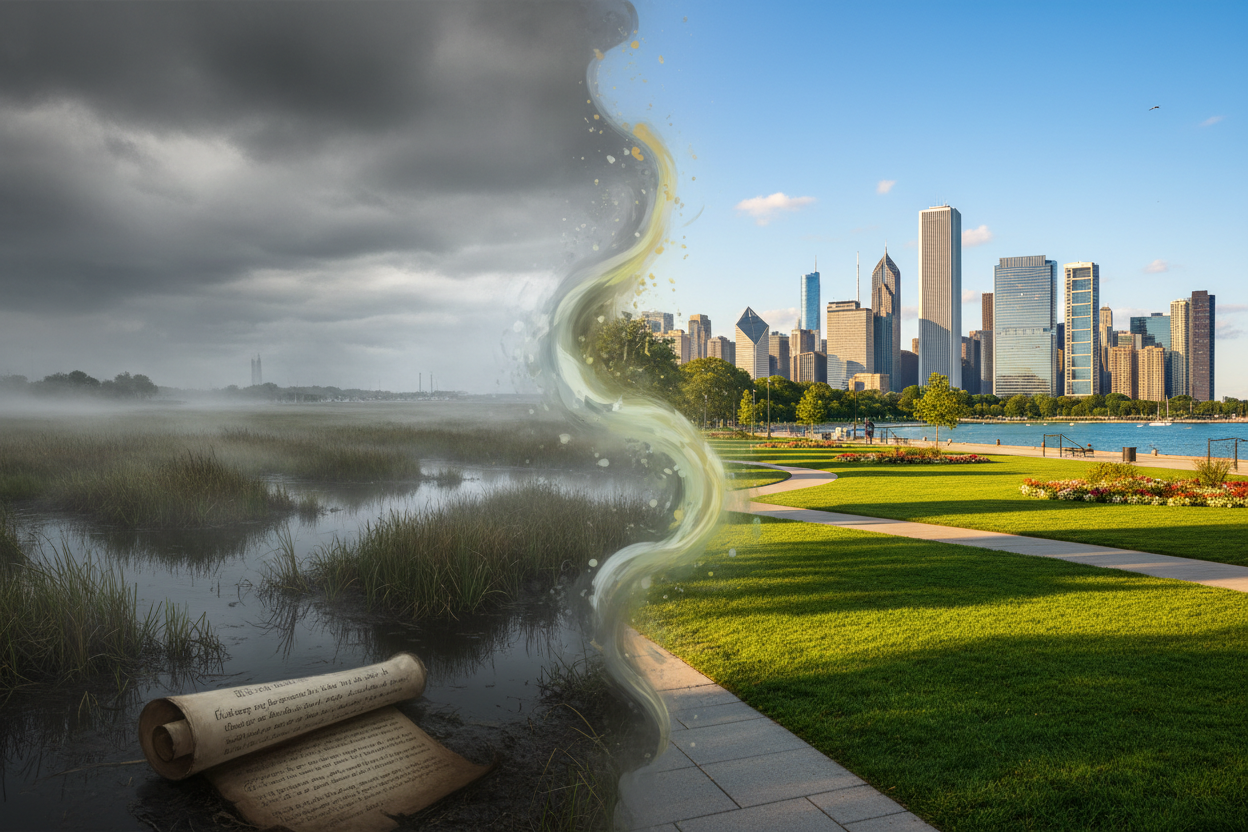
The original shoreline sat much closer to what is now Michigan Avenue, and the marshy wetlands provided perfect hunting grounds for waterfowl and small game. Native American trading routes crisscrossed this area, connecting the Great Lakes region with communities throughout the Midwest. These ancient pathways would later influence the street grid system that Daniel Burnham incorporated into his famous 1909 Plan of Chicago.
What’s particularly fascinating is that recent archaeological surveys have uncovered pottery shards and tool fragments dating back over 1,000 years, suggesting continuous human habitation long before European settlers arrived. These discoveries challenge the common narrative that Chicago was merely a “wilderness” before white settlement, revealing instead a landscape actively shaped by indigenous communities for generations.
From Swampland to “Public Ground Forever”
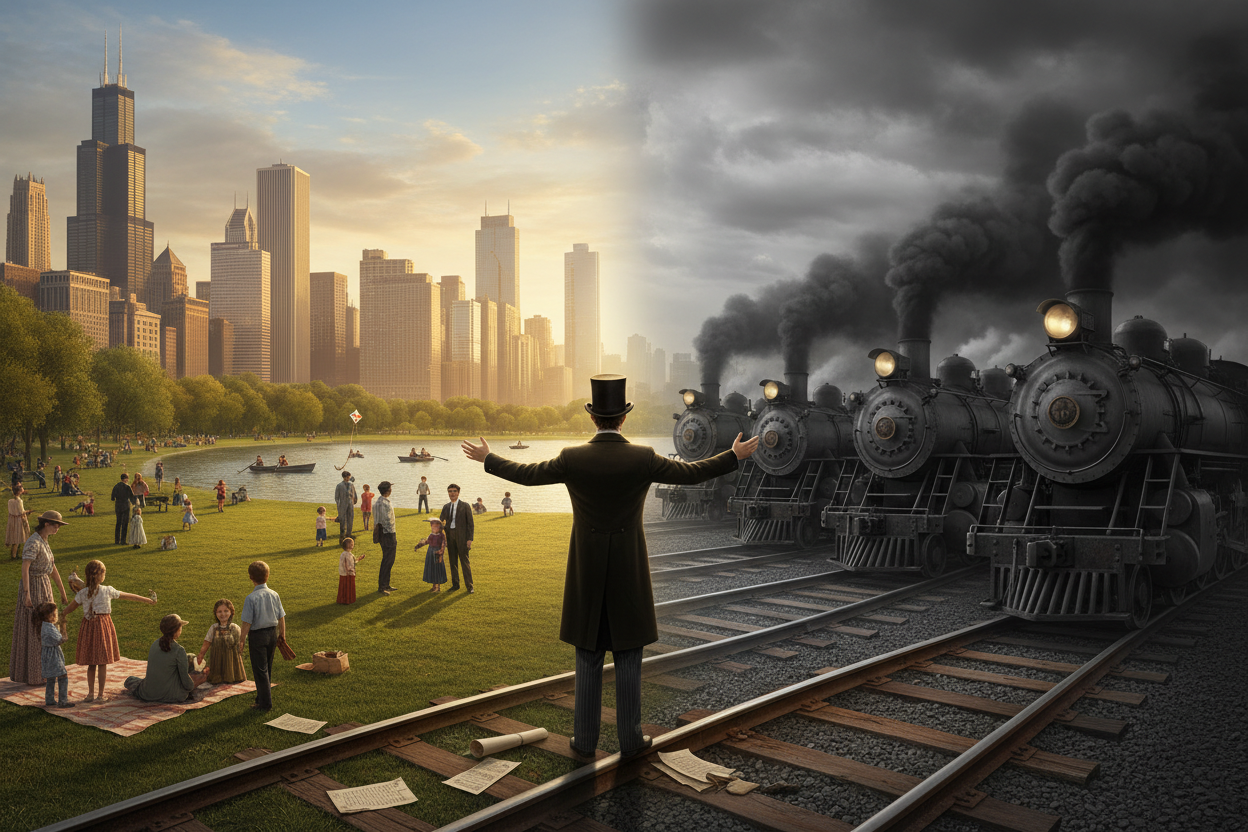
The transformation of Grant Park from marshy wetlands to Chicago’s crown jewel began with a legal battle that would define the city’s relationship with its lakefront for generations. In 1835, when Chicago was incorporated as a city, the Illinois and Michigan Canal Commissioners designated the area as “Public Ground—A Common to Remain Forever Open, Clear and Free.” This seemingly simple declaration would become one of the most contentious phrases in Chicago’s legal history.
The early years saw constant encroachment attempts by railroad companies, particularly the Illinois Central Railroad, which wanted to build tracks directly along the lakefront. The legal fights were fierce, with prominent Chicagoans like Montgomery Ward leading the charge to protect the public space. Ward filed lawsuit after lawsuit, earning him the nickname “the watchdog of the lakefront” and ensuring that Grant Park remained accessible to all citizens regardless of economic status.
During this period, the park existed more as a concept than reality. Much of the area remained underwater or marshy, requiring massive landfill projects to create usable space. The debris from the Great Chicago Fire of 1871 actually helped build portions of what would become Grant Park, as tons of rubble were dumped into the lake to extend the shoreline eastward.
The World’s Columbian Exposition Connection
While the 1893 World’s Columbian Exposition took place primarily in Jackson Park on Chicago’s South Side, Grant Park played a crucial supporting role that most history books overlook. The area served as a staging ground for construction materials and equipment bound for the fairgrounds, and temporary structures housed overflow exhibits and administrative offices.
More significantly, the exposition’s success influenced Daniel Burnham’s vision for Grant Park’s future development. Burnham, who served as the fair’s chief architect, saw the potential for creating a permanent “White City” effect in downtown Chicago. His observations of how visitors interacted with the exposition’s grand spaces and cultural institutions directly informed his later plans for Grant Park’s museum campus and formal gardens.
The exposition also introduced Chicago to the concept of large-scale public art installations, a tradition that continues today with Grant Park’s numerous sculptures and monuments. The temporary plaster statues from the fair were eventually replaced with permanent bronze and stone works, many of which found their way into Grant Park’s evolving landscape.
Underground Secrets: The Pedway Connection
Beneath Grant Park’s surface lies one of Chicago’s best-kept secrets: an extensive network of tunnels and underground passages that connect the park to downtown buildings, parking garages, and transportation hubs. This underground city, known locally as the Pedway, includes sections that date back to the early 1900s and others built as recently as the 1990s.
The original tunnels were constructed for practical purposes—moving steam pipes, electrical cables, and water mains without disrupting the park’s surface. However, during World War II, some sections were reinforced and expanded as potential air raid shelters. City planners worried that Grant Park’s open spaces made downtown Chicago vulnerable to aerial attacks, so they quietly developed contingency plans for moving large populations underground.
Today, these tunnels serve a more mundane but equally important function, allowing thousands of commuters to move between Union Station, the Art Institute, and various downtown buildings without ever stepping outside. Urban explorers and architecture enthusiasts often seek out the lesser-known entrances, though many sections remain restricted to authorized personnel only.
The Buckingham Fountain Mysteries
Grant Park’s crown jewel, Buckingham Fountain, holds secrets that extend far beyond its impressive water displays and nightly light shows. Donated by Kate Buckingham in 1927 as a memorial to her brother Clarence, the fountain’s design incorporates symbolic elements that most visitors never notice.
The four seahorses surrounding the central jet represent the four states that border Lake Michigan: Illinois, Indiana, Michigan, and Wisconsin. However, the original plans included a fifth seahorse representing Minnesota, which was removed when designers realized Minnesota doesn’t actually touch Lake Michigan. The error wasn’t discovered until construction was well underway, leading to hasty design modifications that are still visible to trained eyes.
More intriguingly, Kate Buckingham insisted on several unusual specifications that puzzled contractors at the time. The fountain’s pumping system was overengineered to handle twice the water volume actually needed, and the electrical systems included redundancies that seemed excessive for a decorative fountain. Recent research suggests Buckingham may have envisioned the fountain serving as an emergency water source during citywide crises, reflecting the disaster-preparedness mindset that followed the Great Chicago Fire.
Millennium Park: The Controversial Crown Jewel
The creation of Millennium Park in the late 1990s and early 2000s represented the most dramatic transformation of Grant Park since its inception, but the project’s history is filled with political intrigue, budget overruns, and heated public debates that continue to this day.
Originally budgeted at $150 million, the final cost exceeded $475 million, making it one of the most expensive public works projects in Chicago’s history. Mayor Richard M. Daley pushed the project forward despite fierce opposition from fiscal conservatives and some community groups who argued the money should be spent on schools and infrastructure in underserved neighborhoods.
The selection process for Millennium Park’s signature art installations reveals fascinating behind-the-scenes maneuvering. Anish Kapoor’s “Cloud Gate” (affectionately known as “The Bean”) was actually the second choice for the park’s centerpiece sculpture. The original selection, a massive abstract piece by a different artist, was quietly shelved after focus groups responded negatively to preliminary designs.
Crown Fountain’s interactive video displays caused unexpected technical challenges that required innovative solutions. The original plan called for static sculptural faces, but artist Jaume Plensa convinced city officials to install LED screens capable of displaying moving images. The engineering required to make waterproof, outdoor-rated video displays function reliably in Chicago’s harsh climate pushed technological boundaries and influenced similar projects worldwide.
Music and Memory: The Petrillo Music Shell Legacy
Hidden in plain sight within Grant Park stands the Petrillo Music Shell, a venue that has hosted some of the most significant musical performances in Chicago’s history while also serving as a flashpoint for social and political movements. Named after James Petrillo, the controversial head of the Chicago Federation of Musicians, the venue’s history reflects the city’s complex relationship with labor unions, racial integration, and cultural expression.
During the 1960s and 1970s, the music shell became an unofficial headquarters for civil rights demonstrations and anti-war protests. The Chicago Freedom Movement held rallies here, and the venue’s acoustics allowed speakers to address crowds of tens of thousands without electronic amplification. City officials often found themselves in the awkward position of providing security for events they politically opposed, leading to tense standoffs that occasionally erupted into violence.
The shell’s design incorporates acoustic principles developed for ancient Greek amphitheaters, but with modern materials and engineering. The curved backdrop isn’t just decorative—it’s precisely calculated to reflect sound waves back toward the audience, creating natural amplification that works even without modern sound systems. This feature proved crucial during the early years when electronic equipment was unreliable and expensive.
The Future of Chicago’s Front Yard
As Grant Park approaches its second century as Chicago’s premier public space, new challenges and opportunities continue to shape its evolution. Climate change threatens the park’s lakefront location with rising water levels and more frequent severe weather events. City planners are quietly developing adaptation strategies that may dramatically alter the park’s appearance and functionality over the coming decades.
Recent archaeological surveys conducted during routine maintenance have uncovered additional Native American artifacts, prompting discussions about how to better acknowledge and honor the area’s indigenous history. Tribal representatives have been consulted about potential memorial installations or interpretive programs that could educate visitors about the land’s pre-European heritage.
The park’s role as a festival venue continues to evolve, with new events pushing the boundaries of what’s possible in an urban green space. However, balancing public access with environmental protection remains an ongoing challenge, as heavy foot traffic and large-scale events take their toll on grass, trees, and soil.
Conclusion: More Than Meets the Eye
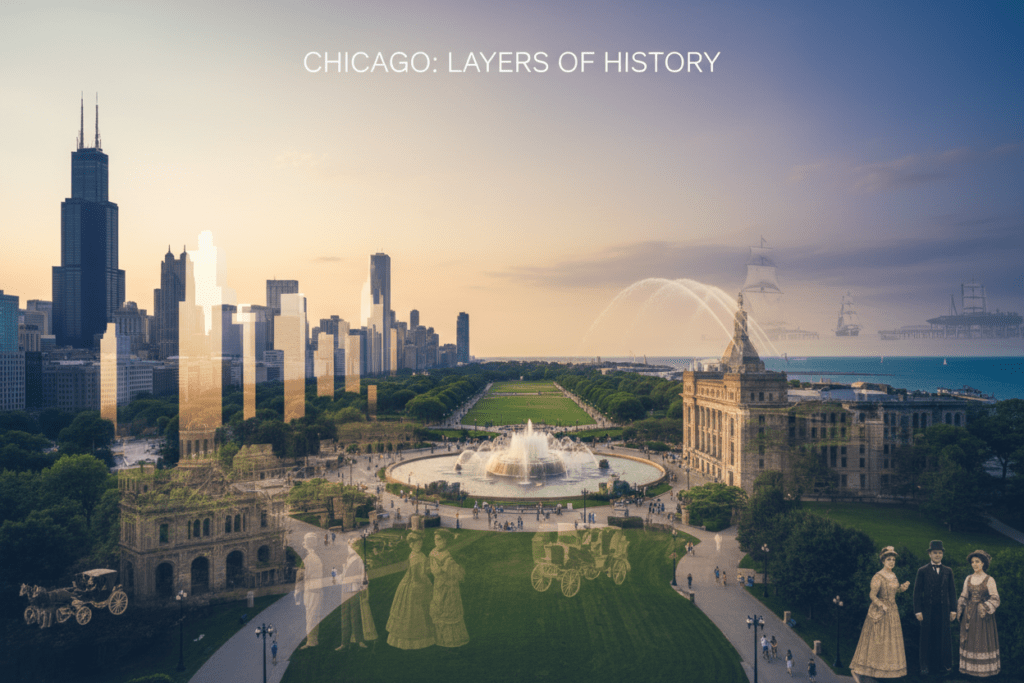
Grant Park’s hidden history reveals a complex narrative that extends far beyond its role as a pretty backdrop for downtown Chicago. From ancient Native American settlements to cutting-edge public art installations, from legal battles that shaped municipal law to underground tunnels that connect the city’s past with its future, Chicago’s Front Yard contains multitudes.
The next time you find yourself walking through Grant Park—whether you’re rushing to catch a train, attending a summer festival, or simply enjoying a quiet moment by Buckingham Fountain—take a moment to consider the layers of history beneath your feet. Every path you follow, every view you admire, and every structure you encounter represents decisions made by countless individuals over more than a century and a half.
Understanding Grant Park’s hidden history doesn’t just satisfy curiosity; it provides insight into how cities evolve, how public spaces serve communities, and how the past continues to influence the present. In a rapidly changing urban landscape, Grant Park stands as both a testament to Chicago’s ambitions and a reminder that the most important stories aren’t always the most visible ones.