
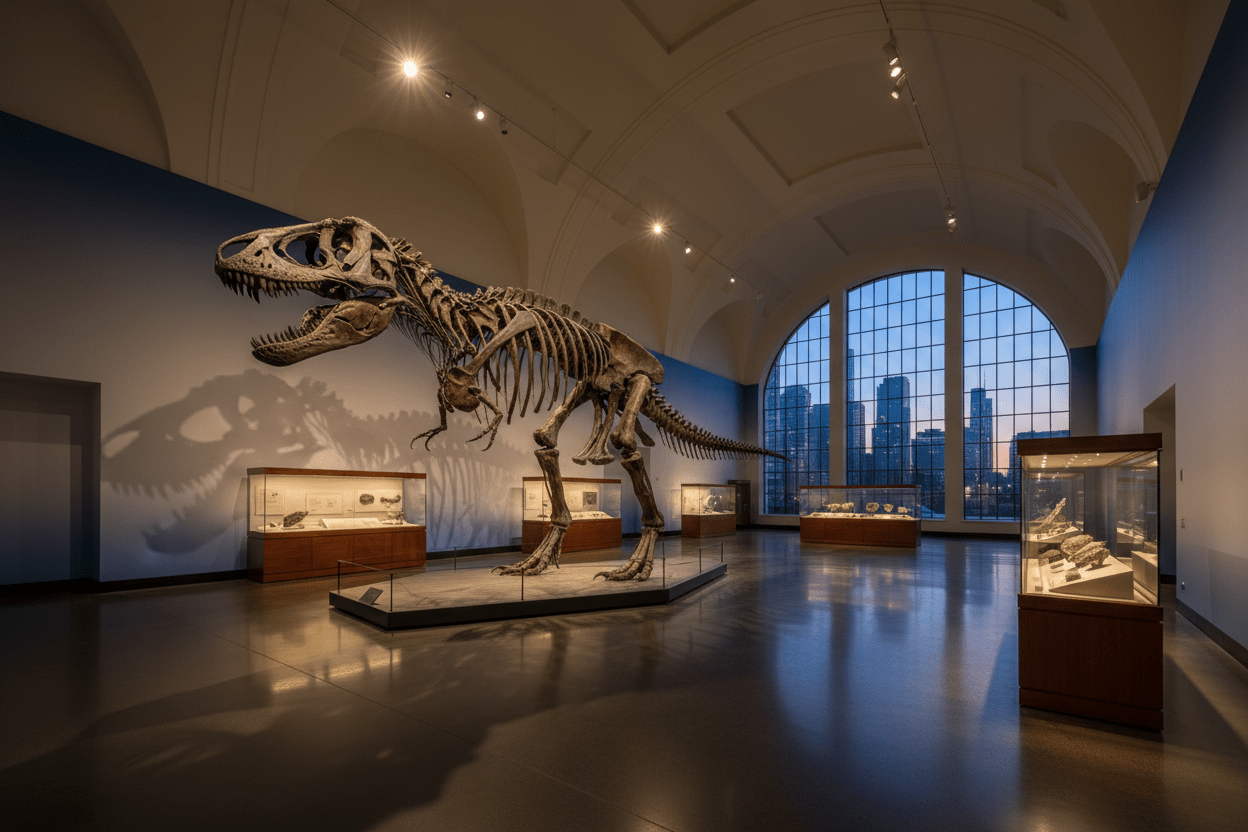
The Field Museum’s Sue: How Chicago Became Home to the World’s Most Famous T-Rex
Standing majestently in Chicago’s Field Museum, Sue the Tyrannosaurus Rex has captured the hearts and imaginations of millions of visitors since taking up residence in the Windy City. But how did this 67-million-year-old celebrity end up calling Chicago home? The story behind Sue’s journey to the Field Museum is as fascinating as the dinosaur herself, involving legal battles, record-breaking auctions, and a community’s determination to secure one of paleontology’s greatest treasures.
Sue isn’t just any dinosaur skeleton – she represents the most complete and best-preserved T-Rex specimen ever discovered. Her story intertwines scientific discovery, legal drama, and Chicago’s commitment to world-class natural history education. Today, Sue stands as both a scientific marvel and a beloved Chicago icon, drawing visitors from around the globe to witness her impressive 40-foot length and towering 13-foot height.
The Discovery That Changed Paleontology Forever
In August 1990, paleontologist Sue Hendrickson made the discovery of a lifetime in the badlands of South Dakota. While exploring near the town of Faith, Hendrickson spotted some large bones eroding from a cliff face on the Cheyenne River Sioux Reservation. What she had found would later be identified as the most complete Tyrannosaurus Rex skeleton ever unearthed, with over 90% of the bones intact.
The skeleton was excavated by a team from the Black Hills Institute of Geological Research, led by Peter Larson. They named the dinosaur “Sue” in honor of its discoverer, not knowing at the time that this T-Rex would become the center of one of paleontology’s most controversial legal battles. The excavation itself was a monumental task, requiring careful removal of tons of rock and sediment to preserve every precious bone.
What made Sue so special wasn’t just her completeness, but also her size and the exceptional preservation of her bones. Scientists could see evidence of injuries she had sustained during her lifetime, including what appeared to be bite marks from other T-Rex encounters. These details would later provide invaluable insights into T-Rex behavior and biology, making Sue not just a museum centerpiece but a crucial scientific specimen.
The Legal Battle That Gripped the Scientific Community
Sue’s path to Chicago was far from straightforward. Shortly after her discovery, a complex legal battle erupted over ownership rights. The federal government seized Sue in 1992, claiming that the Black Hills Institute had illegally collected the fossil from federal trust land without proper permits. This sparked a years-long legal dispute that would determine Sue’s ultimate fate.
The case involved multiple parties: the Black Hills Institute, the landowner Maurice Williams, the Cheyenne River Sioux Tribe, and the federal government. Each claimed some right to the fossil, creating a legal maze that took years to untangle. During this time, Sue remained in government custody, stored away from public view while lawyers argued over her ownership.
The scientific community watched anxiously as this legal drama unfolded. Many feared that Sue might end up in private hands, potentially limiting scientific access to this invaluable specimen. The case highlighted the complex issues surrounding fossil collection and ownership, particularly on Native American lands, and led to important discussions about fossil rights and scientific access.
The Record-Breaking Auction That Made Headlines
In 1997, the courts finally ruled that Maurice Williams, the landowner, was the rightful owner of Sue. Williams decided to sell the fossil at auction through Sotheby’s in New York, setting up what would become one of the most watched auctions in natural history. The scientific community held its breath, hoping that Sue would end up in a museum rather than a private collection.
The auction took place on October 4, 1997, and the bidding was intense. When the hammer finally fell, Sue had sold for a record-breaking $8.36 million, making her the most expensive fossil ever sold at auction. The winning bid came from a consortium led by the Field Museum, with significant financial support from McDonald’s Corporation and Disney’s Walt Disney World Resort.
This collaborative effort to secure Sue for public display demonstrated the importance that major corporations and institutions placed on keeping significant scientific specimens accessible to researchers and the public. The partnership between the Field Museum, McDonald’s, and Disney ensured that Sue would have a permanent home where millions of people could visit her and where scientists could continue to study her remains.
Sue’s Grand Arrival in Chicago
Sue’s arrival in Chicago was treated like a celebrity homecoming. The Field Museum organized a massive celebration to welcome their new star attraction, and the media coverage was extensive. Chicago residents embraced Sue immediately, recognizing that their city had just acquired one of the world’s most significant paleontological treasures.
The process of preparing Sue for display was incredibly complex and time-consuming. Each of her 250+ bones required careful cleaning, conservation, and mounting. The Field Museum’s preparation team worked for years to ready Sue for her public debut, using the latest techniques in fossil preparation and display technology.
During the preparation process, scientists made numerous discoveries about Sue’s life and death. They found evidence of broken ribs that had healed, suggesting she had survived significant injuries. They also discovered that Sue had suffered from various ailments, including what appeared to be gout and possibly a brain tumor. These findings provided unprecedented insights into T-Rex health and longevity.
Sue’s Impact on Chicago and Beyond
Since going on display in 2000, Sue has become one of Chicago’s most beloved attractions. The Field Museum estimates that over 18 million people have visited Sue, making her one of the most-seen dinosaur specimens in the world. Her presence has significantly boosted tourism to Chicago and has helped establish the Field Museum as one of the premier natural history museums globally.
Sue’s impact extends far beyond tourism numbers. She has inspired countless children to develop interests in paleontology, natural history, and science in general. Teachers regularly bring school groups to see Sue, using her as a tangible connection to Earth’s prehistoric past. The educational programs built around Sue have reached hundreds of thousands of students over the years.
The scientific research conducted on Sue has also been groundbreaking. Studies of her bones have revealed new information about T-Rex growth patterns, behavior, and physiology. Researchers have used advanced imaging techniques to peer inside her bones without damaging them, discovering details about her age and health that were previously unknown.
Sue’s New Home and Continued Legacy
In 2018, Sue underwent another major transition when she was moved to a new location within the Field Museum. Her new home in the Griffin Halls of Evolving Planet provides even more space and better viewing angles for visitors. The move also allowed the museum to incorporate the latest research findings into Sue’s display, including new theories about T-Rex behavior and appearance.
The relocation wasn’t just about better presentation – it also reflected evolving scientific understanding. New research had suggested that the original mounting position might not have been entirely accurate, so Sue was remounted in a more scientifically precise pose. This attention to scientific accuracy demonstrates the Field Museum’s commitment to presenting the most current understanding of these magnificent creatures.
Sue’s legacy continues to grow as new technologies allow scientists to learn even more from her remains. Advanced CT scanning, chemical analysis, and other modern techniques are revealing secrets that were locked in her bones for 67 million years. Each new discovery adds to our understanding of these apex predators and their world.
Why Sue Matters More Than Ever
In an age of digital entertainment and virtual experiences, Sue represents something irreplaceably authentic – a direct connection to Earth’s deep past. Standing before her massive skeleton, visitors experience a sense of awe and wonder that no digital recreation can match. She serves as a powerful reminder of the incredible diversity of life that has existed on our planet.
Sue also represents the importance of scientific institutions and public access to natural treasures. The collaborative effort that brought her to Chicago demonstrates what can be achieved when museums, corporations, and communities work together for the public good. Her story shows how significant scientific specimens can be preserved for future generations while remaining accessible to researchers and the public.
For Chicago, Sue has become more than just a museum exhibit – she’s a symbol of the city’s commitment to education, science, and culture. She represents Chicago’s place on the world stage as a center for learning and discovery. Visitors often leave the Field Museum with a new appreciation not just for paleontology, but for Chicago itself.
Sue the T-Rex’s journey from the badlands of South Dakota to the halls of Chicago’s Field Museum is a testament to the power of scientific collaboration, legal perseverance, and community commitment. Her story reminds us that the most important discoveries belong not to individuals or corporations, but to all of humanity. Today, as Sue continues to educate and inspire millions of visitors, she stands as proof that Chicago made the right choice in bringing her home. In the Windy City, Sue has found her perfect resting place – surrounded by curious minds, dedicated scientists, and countless visitors eager to connect with the prehistoric past.