
Navy Pier Then and Now: The Transformation of Chicago’s Most Popular Attraction
Standing at the edge of Lake Michigan, Navy Pier stretches majestically into the water like a finger pointing toward endless possibilities. Today, millions of visitors flock to this iconic Chicago landmark, but few realize they’re walking through layers of fascinating history. From its humble beginnings as a shipping and naval facility to its current status as the Midwest’s premier tourist destination, Navy Pier’s transformation tells the remarkable story of Chicago’s evolution and resilience.
The pier we know and love today bears little resemblance to its original incarnation. What started as a purely functional structure has blossomed into a vibrant entertainment complex that captures the heart and soul of Chicago. This journey through time reveals not just architectural changes, but the shifting needs and dreams of a great American city.
The Early Days: Municipal Pier No. 2 (1916-1927)
When Navy Pier first opened its doors in 1916, it wasn’t called Navy Pier at all. Originally christened “Municipal Pier No. 2,” this ambitious project was the brainchild of architect Charles Sumner Frost and engineer Edward H. Bennett. The pier stretched an impressive 3,300 feet into Lake Michigan, making it the largest pier in the world at that time.
The original vision was purely practical. Chicago needed a modern shipping facility to handle the growing commercial traffic on the Great Lakes. The pier featured massive freight sheds, passenger terminals, and even a streetcar line that connected visitors directly to downtown Chicago. In those early days, you might have seen elegant steamships docking alongside cargo vessels, while well-dressed passengers disembarked for their Chicago adventures.
What made Municipal Pier No. 2 special wasn’t just its size, but its dual purpose. While one end handled serious shipping business, the other end was designed for recreation. The pier featured a grand ballroom, exhibition spaces, and even outdoor concerts. This early blend of commerce and entertainment would prove prophetic of the pier’s future transformation.
The Naval Years: Service and Sacrifice (1927-1965)
In 1927, the pier underwent its first major identity shift when it was renamed Navy Pier in honor of naval veterans from World War I. However, it was during World War II that the pier truly earned its military stripes. The U.S. Navy took over the facility, transforming it into a bustling training center for aircraft carrier pilots.
During these war years, the pier hummed with activity of a different sort. Instead of tourists and cargo ships, you’d find young sailors learning the skills that would serve them in the Pacific Theater. The pier’s long runway made it perfect for carrier landing practice, and its large buildings housed classrooms and barracks. Over 60,000 pilots trained at Navy Pier during the war, making it a crucial piece of America’s victory effort.
After the war, the pier continued to serve educational purposes when the University of Illinois established a temporary campus there. From 1946 to 1965, thousands of students attended classes in converted military buildings. This period, often called the “Harvard of the Midwest,” saw the pier transform once again, this time into a beacon of higher education for returning veterans taking advantage of the GI Bill.
The Forgotten Years: Decline and Neglect (1965-1990s)
The departure of the University of Illinois in 1965 marked the beginning of Navy Pier’s darkest chapter. For nearly three decades, this once-proud landmark fell into disrepair and neglect. The grand buildings that had once welcomed steamship passengers and trained naval aviators now stood largely empty, their windows boarded up against Lake Michigan’s harsh winters.
During these forgotten years, the pier became something of an urban wasteland. While parts of it continued to function as exhibition space and parking, much of the structure deteriorated. Paint peeled, concrete cracked, and weeds grew through sidewalks. Many Chicagoans avoided the area entirely, viewing it as an eyesore rather than an asset.
Yet even in decline, Navy Pier retained a certain haunting beauty. The bones of its grand architecture remained sound, and its prime lakefront location continued to offer spectacular views of the Chicago skyline. Forward-thinking city planners began to envision what the pier could become with proper investment and imagination.
The Grand Reopening: A New Vision Takes Shape (1995)
The transformation that would make Navy Pier Chicago’s most popular attraction began in earnest during the early 1990s. The city invested $150 million in a comprehensive renovation that would completely reimagine the pier’s purpose and appearance. When Navy Pier reopened in 1995, visitors could hardly believe their eyes.
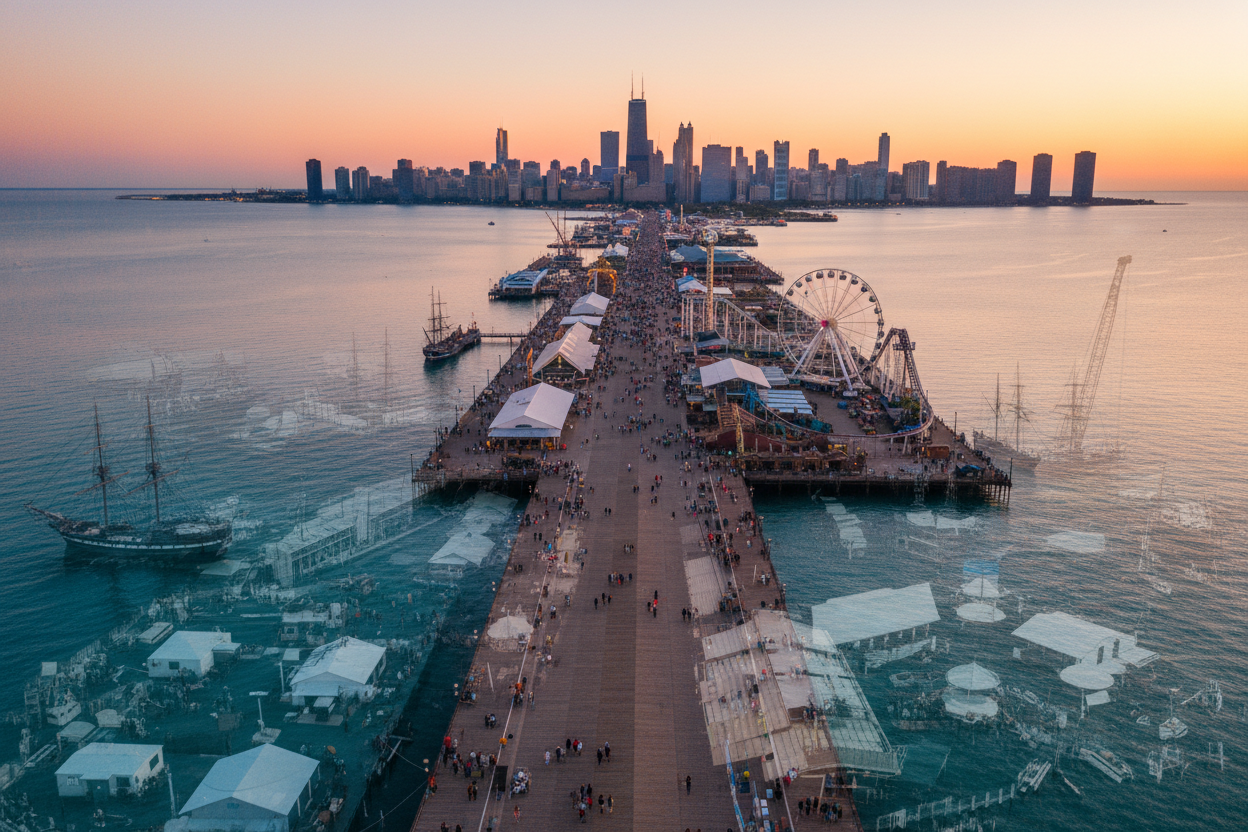
The centerpiece of the new Navy Pier was the spectacular Ferris wheel, standing 150 feet tall and offering breathtaking views of Lake Michigan and the Chicago skyline. The wheel became an instant icon, visible from miles away and serving as a beacon that drew visitors from around the world. Suddenly, Navy Pier wasn’t just a place you passed by – it was a destination worth seeking out.
The renovation also included the construction of Festival Hall, a massive space for exhibitions and events, and the restoration of the pier’s historic ballroom. Restaurants, shops, and entertainment venues filled spaces that had stood empty for decades. The IMAX theater brought cutting-edge cinema to the lakefront, while the Chicago Children’s Museum provided educational fun for families.
Modern Marvels: Today’s Navy Pier Experience
Today’s Navy Pier is a far cry from its utilitarian origins. The most recent major renovation, completed in 2016 as part of the “Centennial Vision,” added even more spectacular features to this already impressive destination. The original Ferris wheel was replaced with an even taller, more modern version that stands 196 feet high and features climate-controlled gondolas for year-round comfort.
Walking through Navy Pier today feels like exploring a small city dedicated to entertainment and wonder. The Crystal Gardens, a one-acre indoor botanical garden, provides a tropical escape even in the depths of Chicago’s winters. Street performers entertain crowds along the pier’s wide promenades, while the Chicago Shakespeare Theater presents world-class productions in its stunning lakefront venue.
The dining scene at Navy Pier has evolved tremendously as well. While early visitors might have grabbed a simple hot dog from a cart, today’s guests can choose from dozens of restaurants ranging from casual family eateries to upscale establishments with panoramic lake views. The beer garden offers local craft brews with outdoor seating that takes full advantage of the pier’s spectacular setting.
Entertainment Evolution: From Ballrooms to Blockbusters
Perhaps nowhere is Navy Pier’s transformation more evident than in its entertainment offerings. The original pier featured a single ballroom and occasional outdoor concerts. Today’s visitors can choose from an incredible array of entertainment options that cater to every taste and age group.
The Chicago Children’s Museum has become a destination in itself, featuring interactive exhibits that make learning an adventure. Kids can climb through a three-story schooner, experiment with water play, or explore a miniature city designed just for them. Meanwhile, adults can catch a show at the Chicago Shakespeare Theater, which has gained international recognition for its innovative productions.
The pier’s calendar is packed year-round with festivals, fireworks shows, and special events. Summer brings outdoor concerts and the spectacular Wednesday and Saturday night fireworks displays that light up the entire lakefront. Winter transforms the pier into a wonderland with special holiday programming and the magical glow of thousands of lights reflecting off Lake Michigan’s icy surface.
Architectural Renaissance: Preserving History While Embracing the Future
One of the most impressive aspects of Navy Pier’s transformation has been the careful balance between preserving its historic character and embracing modern innovation. The pier’s distinctive headhouse, with its iconic clock tower, has been meticulously restored to its original grandeur while being updated with modern amenities and accessibility features.
The wide promenades that once accommodated cargo and military vehicles now provide spacious walkways for millions of annual visitors. Original architectural details have been preserved and highlighted, creating a sense of continuity between the pier’s past and present. New additions, like the contemporary design of the Centennial Wheel and modern retail spaces, complement rather than compete with the historic elements.
This thoughtful approach to renovation has created a unique atmosphere where visitors can feel connected to Navy Pier’s rich history while enjoying thoroughly modern amenities. The result is a destination that appeals to history buffs and families alike, offering something meaningful for every generation.
Economic Impact: From Shipping Hub to Tourism Powerhouse
The economic transformation of Navy Pier mirrors its physical renovation. Where once the pier generated revenue through shipping fees and cargo handling, today it drives Chicago’s economy through tourism, entertainment, and hospitality. Navy Pier now attracts over 8 million visitors annually, making it one of the most visited attractions in the entire Midwest.
This massive influx of visitors has created thousands of jobs, from restaurant servers and retail workers to tour guides and maintenance staff. The pier’s success has also sparked development in the surrounding area, with new hotels, restaurants, and attractions opening to serve the growing number of tourists who want to stay near this iconic destination.
The ripple effects extend throughout Chicago’s economy. Visitors to Navy Pier often explore other parts of the city, stay in downtown hotels, and dine at restaurants throughout the metropolitan area. What began as a simple shipping pier has become an economic engine that helps power one of America’s great cities.
Looking Forward: The Future of Navy Pier
As Navy Pier approaches its second century, plans are already underway for its continued evolution. The success of recent renovations has proven that this historic structure can adapt to changing times while maintaining its essential character. Future developments may include additional entertainment venues, enhanced dining options, and even more spectacular attractions that take advantage of the pier’s unmatched lakefront location.
Sustainability has become a key focus for future planning. New initiatives aim to reduce the pier’s environmental impact while enhancing the visitor experience. Green building practices, energy-efficient lighting, and sustainable transportation options are all part of the vision for Navy Pier’s next chapter.
The pier’s managers are also exploring ways to better integrate the attraction with Chicago’s broader cultural landscape. Partnerships with local museums, theaters, and cultural institutions could create even more reasons for visitors to explore all that Chicago has to offer.
Navy Pier’s transformation from a utilitarian shipping facility to Chicago’s most beloved attraction represents more than just successful urban planning – it’s a testament to the power of vision, investment, and community pride. The pier that once welcomed cargo ships and trained naval aviators now welcomes families from around the world, creating memories that last a lifetime.
As you walk along Navy Pier today, take a moment to imagine the layers of history beneath your feet. Picture the steamships of the 1920s, the young sailors of the 1940s, and the college students of the 1950s. Each era has left its mark on this remarkable place, contributing to the rich tapestry that makes Navy Pier uniquely Chicago.
The story of Navy Pier’s transformation reminds us that great cities are defined not just by their ability to build new attractions, but by their wisdom in preserving and reimagining the treasures they already possess. In transforming Navy Pier, Chicago didn’t just create a tourist destination – it reclaimed a piece of its soul and shared it with the world.