
The Science Behind Chicago’s Elevated Train System: How the L Defies Gravity
Every day, millions of Chicagoans step aboard the iconic “L” trains that snake through the city’s skyline, suspended dozens of feet above the bustling streets below. But have you ever paused mid-commute to wonder about the remarkable engineering feat happening beneath your feet? The Chicago Transit Authority’s elevated train system isn’t just defying gravity—it’s a masterpiece of physics, engineering, and urban planning that has been carrying passengers safely through the Windy City for over a century.
From the moment you hear that distinctive rumble overhead to watching the sleek train cars glide effortlessly around tight curves, the Chicago L represents one of the most sophisticated examples of elevated rail engineering in the world. Understanding the science behind this marvel reveals a fascinating blend of structural engineering, physics principles, and innovative problem-solving that continues to evolve today.
The Foundation of Elevation: How Chicago’s L Stays Aloft
The secret to the Chicago L’s ability to “defy gravity” lies in its robust structural foundation system. Unlike the subway systems that burrow deep underground, Chicago’s elevated trains rely on an intricate network of steel columns, beams, and supports that transfer the enormous weight of moving trains safely to the ground below.
The primary load-bearing elements consist of steel columns spaced approximately every 100 feet along the track. These aren’t just simple posts—they’re engineered marvels designed to handle multiple types of forces simultaneously. Each column must support not only the static weight of the track structure and stations but also the dynamic loads created by moving trains, wind forces, and even seismic activity.
The load distribution system works on a simple yet elegant principle: spreading weight across multiple support points. When a fully loaded train car weighing approximately 65,000 pounds travels across the elevated structure, that weight is distributed through the rail ties, then to the steel beams, down through the columns, and finally into deep concrete foundations that extend well below street level.
Engineering Marvels: The Steel Framework That Makes It Possible
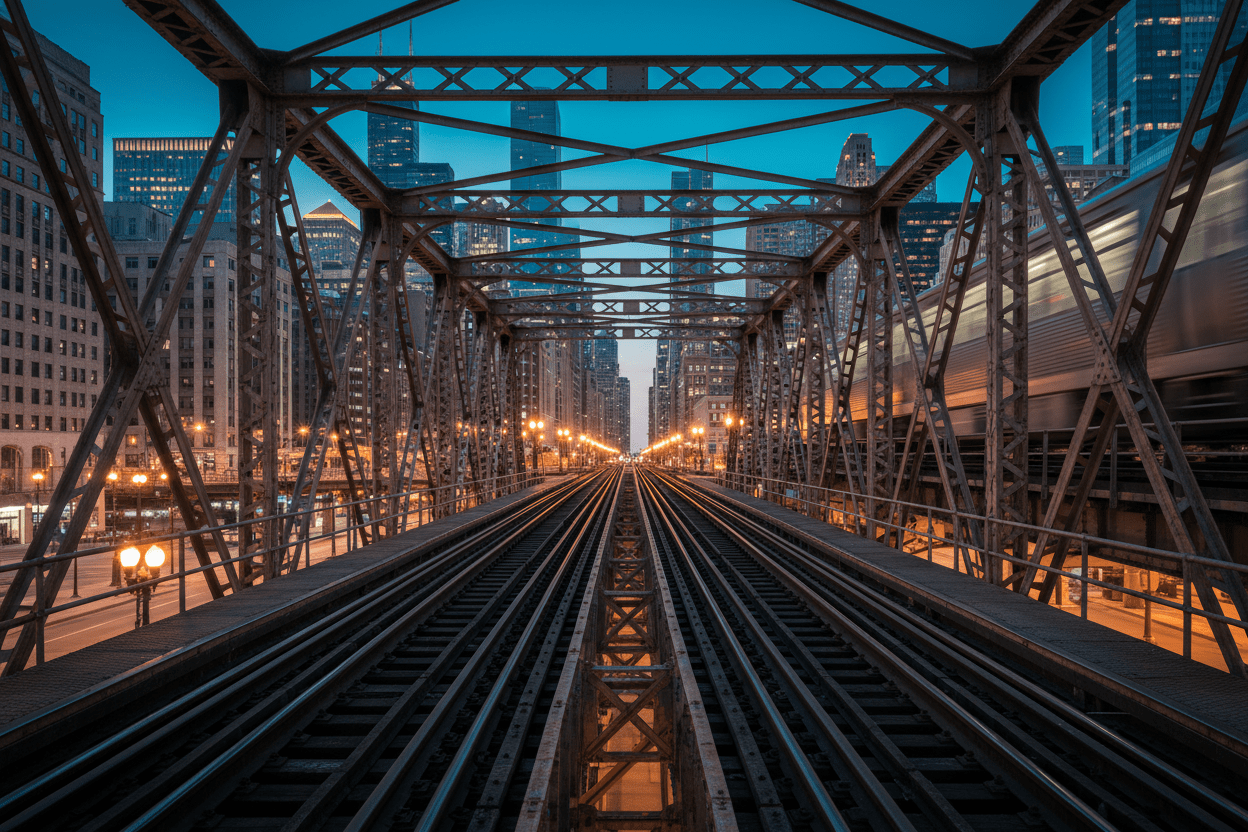
Walking beneath the L tracks reveals the true artistry of structural engineering. The steel framework isn’t just functional—it’s a testament to early 20th-century American industrial ingenuity. The original designers faced a unique challenge: create a rail system that could navigate Chicago’s dense urban grid while minimizing disruption to street-level traffic and commerce.
The solution involved creating a lattice-work of steel beams using riveted connections, a technology that was cutting-edge in the 1890s. These riveted joints distribute stress across multiple connection points, preventing catastrophic failure even if individual components experience wear or damage. Modern sections of the L system now incorporate welded connections and high-strength steel alloys, but the fundamental engineering principles remain unchanged.
One of the most impressive aspects of the L’s design is its ability to handle thermal expansion and contraction. Chicago’s extreme temperature variations—from sub-zero winters to sweltering summers—cause the steel structure to expand and contract significantly. Engineers incorporated expansion joints and flexible connections that allow the structure to “breathe” with temperature changes while maintaining structural integrity.
Curved Track Physics: Navigating Chicago’s Urban Maze
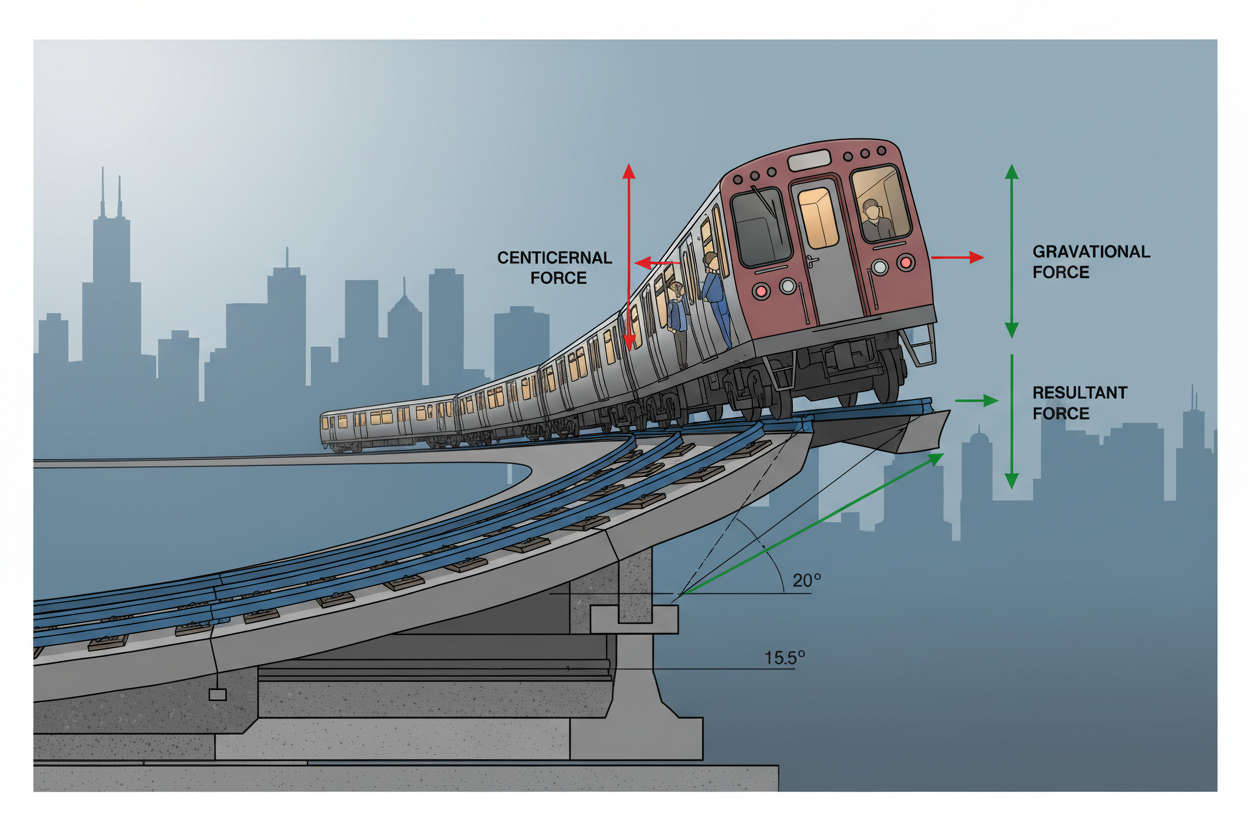
Perhaps nowhere is the engineering brilliance of the L system more apparent than in its famous Loop, where trains navigate sharp curves at relatively high speeds. The physics behind these curved sections involves careful calculation of banking angles, speed limits, and centripetal forces to ensure passenger comfort and safety.
When a train rounds a curve, physics demands that the outer rail be slightly higher than the inner rail—a feature called “superelevation” or banking. This banking angle helps counteract the centrifugal force that would otherwise push passengers toward the outside of the curve. Chicago’s L engineers calculated these angles with remarkable precision, considering factors like typical train speeds, curve radius, and passenger comfort thresholds.
The tight curves in the Loop area, some with radii as small as 90 feet, required special engineering solutions. These sharp turns necessitate slower speeds and specially designed wheel-rail interfaces that can handle the increased lateral forces without excessive wear or noise.
Dynamic Load Management: Handling Moving Masses
Static weight support is only part of the equation. The real engineering challenge lies in managing dynamic loads—the forces created by moving, accelerating, and braking trains. When a 400-ton train accelerates from a station stop, it creates enormous forces that the structure must absorb and dissipate safely.
The L system employs several strategies to manage these dynamic forces. First, the track bed uses a ballast system of crushed stone that helps absorb and distribute impact forces. Modern sections incorporate resilient rail fasteners that provide additional vibration damping while maintaining proper track alignment.
Braking forces present another significant challenge. When trains brake, they create longitudinal forces that try to push or pull the track structure. The continuous welded rail system used throughout much of the L network helps distribute these forces across longer distances, preventing localized stress concentrations that could damage the structure.
Weather Resistance: Engineering for Chicago’s Extreme Climate
Chicago’s notorious weather patterns create unique challenges for elevated rail systems. The combination of extreme cold, heavy snow loads, high winds, and rapid temperature changes would destroy poorly designed structures. The L’s engineers have developed sophisticated solutions to handle these environmental stresses.
Snow and ice management involves more than just plowing tracks. The elevated structure itself must handle additional weight from accumulated snow and ice, while heating systems prevent ice formation on critical components like third rails and switches. The steel structure’s design includes adequate drainage to prevent ice dams and water accumulation that could damage structural elements.
Wind loading represents another significant concern, especially for elevated structures. Chicago’s wind patterns create complex aerodynamic forces on both the structure and moving trains. Engineers calculate wind loads based on historical weather data and design the support structure to handle extreme wind events while maintaining passenger safety and comfort.
Modern Innovations: Technology Meets Tradition
While the fundamental engineering principles of the Chicago L remain unchanged, modern technology has revolutionized how the system operates and maintains its structural integrity. Advanced monitoring systems now continuously track the health of critical structural components, using sensors to detect changes in vibration patterns, stress levels, and structural alignment.
Computer modeling has transformed how engineers analyze and optimize the system’s performance. Finite element analysis allows engineers to simulate complex loading scenarios and predict structural behavior under various conditions. This technology enables more precise maintenance scheduling and helps identify potential problems before they become safety concerns.
The integration of modern materials science has also improved system performance. High-strength steel alloys, advanced concrete formulations, and composite materials now supplement traditional structural elements, providing enhanced durability and reduced maintenance requirements.
Safety Systems: Multiple Layers of Protection
The science behind keeping elevated trains safely on track involves multiple redundant safety systems. Beyond the robust structural engineering, the L employs sophisticated train control systems that monitor speed, spacing, and track conditions in real-time.
Automatic train protection systems can override operator commands if unsafe conditions are detected, while continuous rail monitoring detects broken rails, track misalignment, or structural problems. These electronic systems work in conjunction with regular physical inspections to ensure the structural integrity that allows the L to safely defy gravity day after day.
The elevated design itself provides inherent safety advantages. Unlike ground-level rail systems, elevated tracks eliminate most grade crossing accidents and provide better visibility for operators to detect potential hazards.
The Future of Elevated Rail Engineering
As Chicago continues to modernize its L system, engineers are incorporating cutting-edge technologies while respecting the proven principles that have kept trains running safely for over a century. New construction projects utilize advanced materials and construction techniques, while maintaining compatibility with the existing system’s operational requirements.
Sustainability considerations now drive many engineering decisions. Modern elevated rail design focuses on energy efficiency, reduced environmental impact, and enhanced passenger experience. These considerations include noise reduction technologies, improved accessibility features, and integration with renewable energy systems.
The next generation of Chicago’s elevated trains will likely incorporate magnetic levitation technologies, advanced materials science, and artificial intelligence-driven maintenance systems. However, the fundamental physics and engineering principles that currently allow the L to defy gravity will continue to form the foundation of these future innovations.
The Chicago L stands as a testament to the power of sound engineering principles applied with creativity and precision. Every time you board an L train and feel it smoothly accelerate above the city streets, you’re experiencing more than a century of accumulated engineering knowledge working in perfect harmony with the laws of physics. The science behind this elevated marvel continues to evolve, but its core mission remains unchanged: safely transporting millions of passengers while defying gravity with grace, efficiency, and reliability that has become synonymous with the Chicago experience.